
Lesson 6 - Hop Products
Non-Isomerised Hop Extract
Extraction in this context, is the removal of specific compounds from solid hop material using a solvent. Think of it like removing the flavour of tea (specific compounds) from tea leaves (solid material) into hot water (solvent).
Although many solvents have been used in the past, only two are used today. These are ethanol and carbon dioxide (CO2).
Why these two? Ethanol and CO2 are both found in beer and are considered safe for human consumption (in moderation!). Some of those used historically were toxic!
The main differences between the two solvents are:
- Ethanol – soluble in water and polar.
- CO2 – solubility changes with temperature and pressure and is less polar.
In polar liquids and solvents, the molecules of the liquid/solvent have negative and positive charges. This means they can interact with negative and positive charges on other molecules to hold them in solution. Polar solutes like salts dissolve easily in polar solvents. Water is a good example of a polar solvent. Non-polar solutes like oils and hydrocarbons dissolve best in non-polar solvents. Hexane (a hydrocarbon) is a good example of a non-polar solvent.
What does that mean in practice? Due to ethanol’s more polar nature, ethanol extraction is less selective. It extracts more of the original hop compounds like hard resins and polyphenols than carbon dioxide extraction.
Ethanol hop extract
Ethanol extract is produced by extracting the hops with an ethanol and water mixture. This extracts the soft and hard resins, essential oils and polyphenols. The extract is then separated into what is called the pure resin extract but contains both resins and essential oils and the water soluble polyphenols which are also sometimes called tannin extract.
Preparation
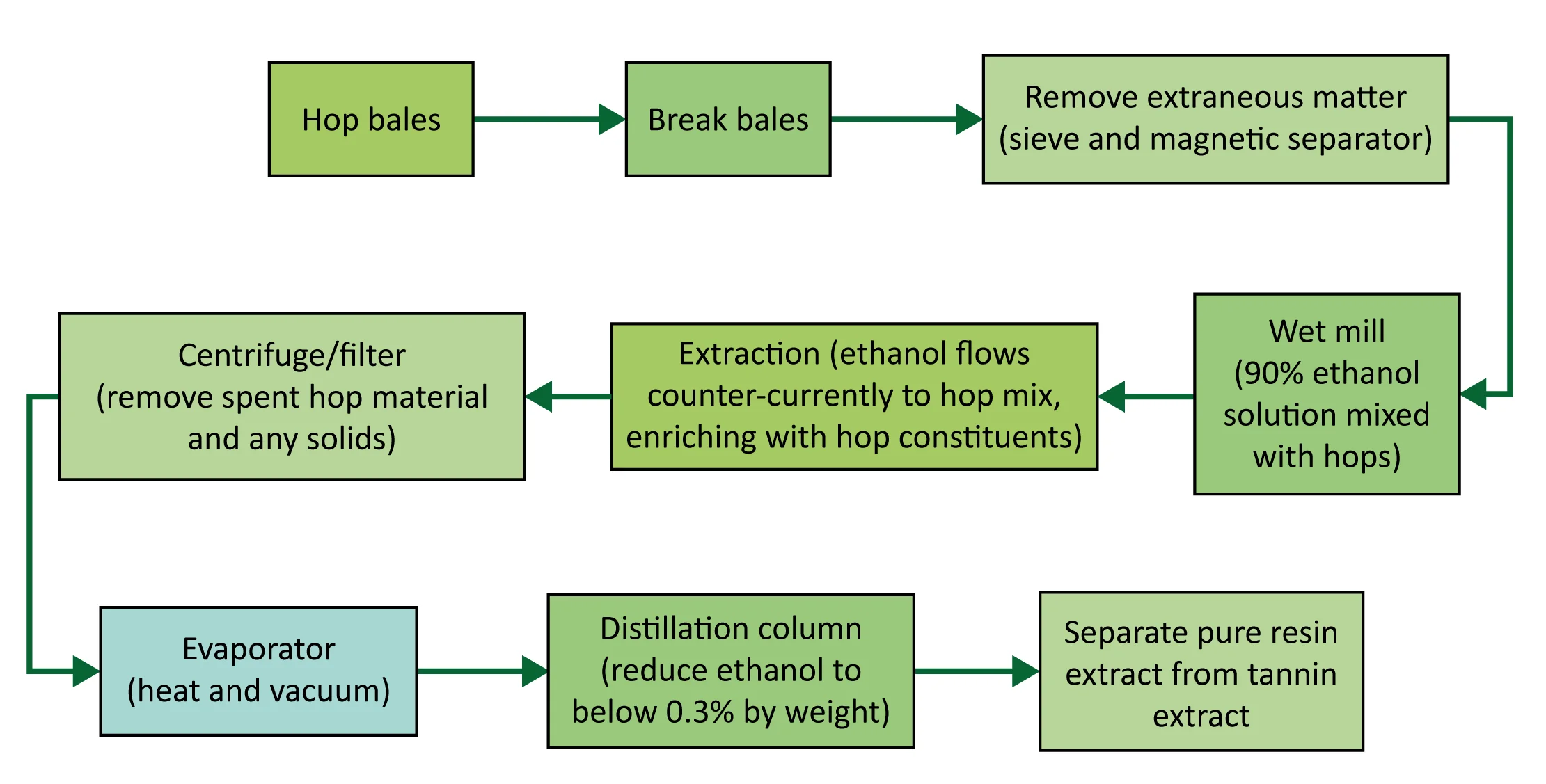
Figure: Production of ethanol hop extracts
Application
Used primarily for bittering although essential oils can contribute to aroma. Ethanol extract can be used as a partial or full replacement for whole hops or pellets. Some ethanol extracts are used in the production of hop oil products.
Point of use
Primarily added to the kettle.
Composition
Table: Average chemical composition of ethanol hop extract compared to whole hop
|
Constituent |
Whole Hop Amount (%) |
Ethanol extract (%) |
|
Total resins |
15-30 |
15-60 |
|
Soft resin – α acids |
2-18 |
8-45 |
|
Soft resin – β acids |
2-14 |
8-20 |
|
Essential oil |
0.5-3 |
0-5 |
|
Hard resins |
2-4 |
2-10 |
|
Polyphenols |
4-12 |
0.5-5 |
|
Waxes |
Trace -5 |
1-20 |
|
Moisture |
8-12 |
1-15 |
Advantages over pellets and whole hops
- High concentration of bitter substances.
- Ethanol is a natural solvent.
- Composition of bitter and aroma compounds is generally similar to the whole hops from which it was extracted.
- Nitrate and pesticides are significantly reduced.
- Less space required for storage.
- Good shelf life (several years).
- Improved utilisation (35-40%).
- Minimal wort/beer losses (as no solid materials are added).
- Contains hard resins – such as xanthohumol.
- Can be free of polyphenols.
Disadvantages
- Small amount of solvent residue (ethanol).
- Highly aroma compounds are driven off in the process (especially myrcene), changing the aroma.
- Lack of polyphenols can affect mouthfeel and bitterness.
- Can make trub removal difficult when sole source of bitterness.
Ethanol extracts are not as popular as CO2 extracts, which make up the majority of extracts sold.
CO2 hop extract
We are all familiar with CO2 as the gas that yeast produces during fermentation. It is not generally considered something that is good at dissolving things. However, by compressing CO2 into a liquid, it can become a solvent.
Two CO2 solvents are used to make hop extracts – liquid CO2 and supercritical CO2. The main differences are:
Liquid CO2 is used at 50 bar and 10-15°C – it is a non-polar solvent. It has a lower overall extraction efficiency, with a higher yield of α-acid.
Supercritical CO2 is used at 250-300 bar and 40-45°C and has the properties of both liquid and gas. It is a more polar solvent, extracting more plant material than liquid CO2.
The key difference between ethanol and CO2 extraction, is that CO2 extraction is more selective, removing less water soluble compounds.
It is generally felt that supercritical CO2 is superior, faster and more flexible (although more expensive) whilst liquid CO2 is better suited for the production of hop oil.
Preparation
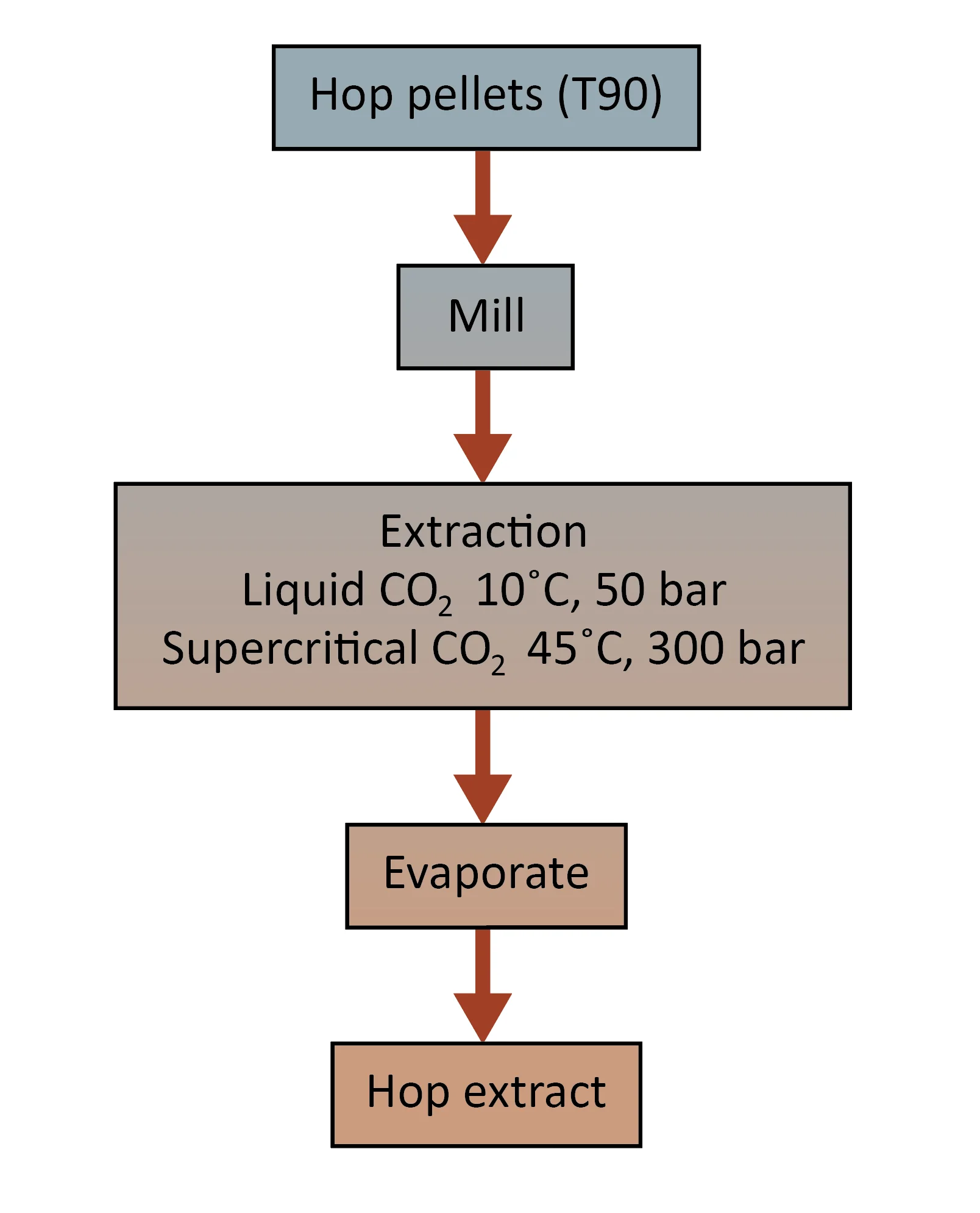
Figure: Production of CO2 hop extract
Application
Mainly used for bittering or further processing into hop oil products.
Point of use
Primarily added to the kettle.
Composition
Table: Average chemical composition of ethanol hop extract compared to whole hop
|
Constituent |
Whole Hop Amount (%) |
Supercritical CO2 (%) |
Liquid CO2 (%) |
|
Total resins |
15-30 |
75-90% |
70-95% |
|
Soft resin – α- acids |
2-18 |
27-55% |
30-60% |
|
Soft resin – β- acids |
2-14 |
23-33% |
15-45% |
|
Essential oil |
0.5–3 |
1-5% |
2-10% |
|
Hard resins |
2-4 |
5-11% |
None |
|
Polyphenols |
4-12 |
0.1-5% |
None |
|
Waxes |
Trace-5 |
4-13% |
0.1-10% |
|
Moisture |
8-12 |
1-7 |
1-5 |
Advantages
- CO2 is a natural solvent.
- Oxidation does not occur during extraction.
- Virtually all of the hop aroma compounds are extracted.
- Soft resins are dissolved with limited extraction of hard resins.
- Only small quantities of polyphenols are extracted.
- Free from nitrates and pesticides.
- α-Acid concentration can be standardised (usually around 30%).
- No need for a hop back.
- Long shelf life.
- Improved utilisation (35-38%).
- Less space required for storage.
- Minimal wort/beer losses.
Disadvantages
- Cost per unit of α-acid is higher than whole cone hops or pellets.
- Containers may need to be heated to reduce viscosity for dosing into wort.
- Can make trub removal difficult when sole source of bitterness.
There are some obvious benefits to using CO2 extracts, although they can be costly. The flavour profile is usually different to whole cone hops or pellets, due to the extraction process.
A quick recap – we have taken a hop cone, and using different methods, removed unnecessary components and concentrated the useful compounds in a pellet or a liquid extract. These products are far more efficient to use than whole cone hops.
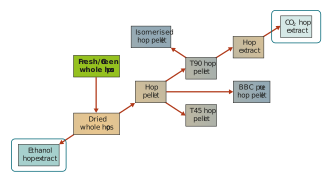
Figure: Overview of hop products and how they are typically derived
However, there is more.
With bittering, the key compounds are the iso-α-acids. Traditionally, producing iso-α-acids from α-acids takes time and heat in the kettle. What if we could carry out this process before addition so we just dissolve the product? Surely this would significantly increase our utilisation and reduce variation in beer bitterness? It’s time to introduce the isomerised hop products!