
Lesson 6 - Hop Products
Isomerised Hop Extracts
A few isomerised extracts are produced and are normally used to add bitterness.
The first isomerised hop products were extracts, as the liquid form allowed for better mixing of the catalyst, a shorter reaction time and a higher conversion rate than with hop pellets.
Isomerised kettle extract (IKE)
This is a CO2 extract and as the name suggests, it is added to the kettle.
A CO2 hop extract is mixed with water and heated to 75-85°C. The pH is increased, using sodium or potassium hydroxide in order to reach the optimum pH for isomerisation (7-10). Magnesium salts are then added as a catalyst to isomerisation, which takes around two hours.
Sulphuric acid is then added to lower the pH to below 2, which causes the isomerised CO2 extract to separate from the liquid containing the magnesium salts.
If potassium salts are used instead of magnesium salts, the product is known as PIKE (potassium isomerised kettle extract).
This product is very easy to store and to use, allowing precise control of bittering due to the standardised iso-α-acid content. IKE can achieve utilisations of around 70%, requiring roughly five minutes to dissolve in the wort. Unlike with pellets very little wort is lost.
Sounds perfect! However, as with all things, this comes at a price, literally! They are a relatively expensive hop product and can also be considered as a chemically processed product. Not all hop varieties are used to make IKE, so we are limited to whichever varieties the manufacturers choose.
Isomerised hop extract (Iso-extract)
An iso-extract is a liquid solution that contains iso-α-acids at a specific concentration (usually around 30%) in the form of potassium salts. This product might be called iso-30 (based on the concentration of iso-α-acids).
The β-acids, essential oils and waxes are separated from the iso-α-acids in an alkaline solution. The separated component is known as a base extract, which is then used as a base for further products, such as β-acid extract and lipid extract.
The pH is then adjusted in the solution containing the iso-α-acids, separating the remaining α-acids from the iso-α-acids. The iso-α-acids are then treated with potassium hydroxide, which makes them more soluble. Finally, the iso-α-acid extract is diluted with deionised water, in order to achieve the target concentration.
This product is a purified form of iso-α-acids (containing no other bittering or aroma compounds) and is best added to beer rather than wort. It should be added before filtration, as it does not completely dissolve. If it is added after filtration, there is an increased risk of haze or gushing (when beer uncontrollably foams out of a bottle when opened).
This post fermentation bittering (PFB) allows for increased hop utilisation. This is because iso-α-acids are not lost in trub, on yeast cells, or fobbing during fermentation – in fact, utilisation of over 90% is possible.
Iso-extract only adds bitterness, and no other flavour (all removed into base extract), so it is not recommended for use as the only hop product in a beer.
However, it is very useful for correcting any deficiencies in bitterness to produce beer with a consistent bitterness.
Unlike other hop extracts, pre-isomerised extracts do not require wort boiling to produce iso-α-acids. As such, iso-extracts can be added directly to the beer for precise control of bittering both before and after fermentation, improving utilisation.
The final bitter hop extracts we cover are known as hydrogenated or reduced hop extracts.
These products are chemically changed to make them more stable, by reducing the unsaturated bonds on the side chains that can be affected by UV light.
This eliminates the opportunity for the formation of the lightstruck flavour in beer – caused by 3-methyl-2-butene-1-thiol (3-MBT). This is the chemical compound that causes the off-flavour in beer, known as lightstruck.
Lightstruck flavour (3-methyl-2-butene-1-thiol)
3-MBT in beer is caused by a light-induced reaction involving riboflavin which acts as a photosensitiser, a sulphur containing compound (such as sulphur containing amino acids) and isohumulone from the hops.
UV light removes (by photolysis) the side chain of the iso-α-acid which reacts with a sulphur free radical. UV light may come from natural sunlight, but also from artificial lighting such as that found in fridges.
3-MBT has a flavour threshold of 4-7 ng/L (a nanogram (ng) per litre is equivalent to a thousand parts per trillion – a very tiny amount!) and has a very unpleasant skunky, onion or garlic like aroma. It is noticeable in beer even at incredibly low concentrations.
If it is sunny outside, pour a beer into two glasses and place one glass of beer outside in the sun and one inside a dark cupboard. Leave them for a few hours and then come back and smell the beer in the two glasses.
Traditionally, the main solution to this problem was to package beer in cans, kegs or brown (and to a lesser extent, green) bottles, to protect the beer against the 350-500 nm wavelength light that caused the reaction.
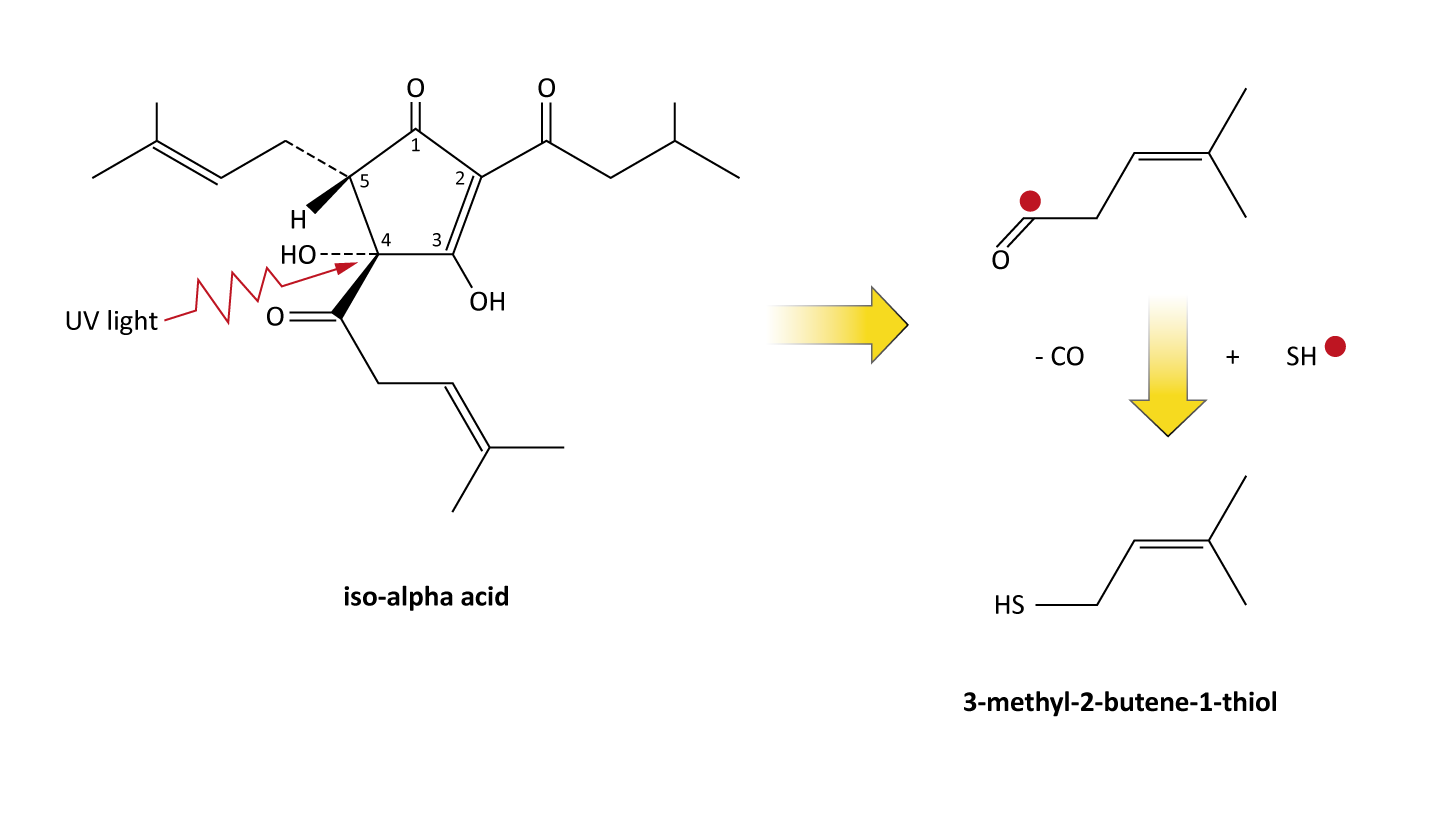
Figure: Production of 3-MBT
However, if the weak double bonds are reduced, then the iso-α-acid cannot be photolysed and the reduced hop compound does not form 3-MBT. This means the beer can be packaged in colourless glass bottles.
Reduced/hydrogenated hop extracts
There are three types of reduced iso-α-acids, namely:
- Rho-hydro iso-α-acids
- Tetra-hydro iso-α-acids
- Hexa-hydro iso-α-acids
Rho-hydro iso-extract
Production of rho-hydro iso-extract (two fold hydrogenation) involves taking normal iso-extract and adding sodium borohydride as the hydrogenation agent. Once the reaction is complete, the hydrogenation agent is removed by dropping the pH to below two. The rho iso-α-acids are then converted to potassium salts, in order to make them more soluble.
The process adds two hydrogen atoms.
Tetra-hydro iso-extract
Iso-α-acids are mixed with hydrogen gas in a pressurised reaction vessel with palladium acting as the hydrogenation catalyst. The palladium is then removed by filtration to be reused in future reactions.
The pH is then lowered, separating the tetra-hydro iso-α-acids, which are then clarified and packaged.
The process adds four hydrogen atoms.
Hexa-hydro iso-extract
Hexa-hydro iso-extract is made from tetra-iso using sodium borohydride as the catalyst. The process is similar to the one used for rho iso-extract.
The process adds six hydrogen atoms.
The figure below shows the catalysts and structures:
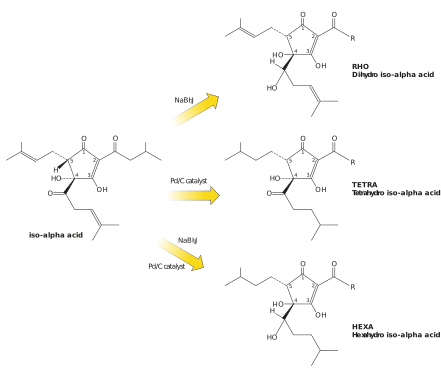
Figure: The production of reduced iso-α-acid compounds
The table below shows some of the attributes of reduced hop extracts.
|
Attribute |
Rho Iso-extract |
Tetra-hydro Iso-extract |
Hexa-hydro Iso-extract |
|
Concentration |
30% |
10% |
10% |
|
Light protection |
Yes (+) |
Very Good (++) |
Very good (++) |
|
Bittering (compared to iso-α-acids) |
60-80% |
160-180% |
100-120% |
|
Foam stability |
Standard |
Excellent (+++) |
Very good(++) |
Not only do these reduced extracts provide light stability, but they also improve foam stability. However, high dosages can lead to an unnatural looking beer foam.
When using reduced hop extracts to make light stable beer, we must ensure that they are the only source of bitterness. Traces of iso-α-acids from equipment or yeast cells are sufficient to form noticeable amounts of 3-MBT, so we must use dedicated yeast and clean all equipment used for brewing with standard hop products before we make light stable beer.
Before we move on, as a number of new hop products have been introduced in this section, let’s update the hop products overview diagram.
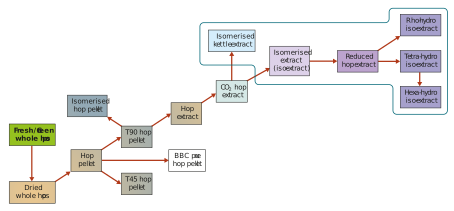
Figure: Overview of hop products and how they are typically derived
We have covered the main hop products used primarily for bitterness.
Next, we cover some of the hop products that are used for providing hop aroma.