
Lesson 6 - Hop Products
Point of reflection – reconvene
Welcome back. So, what were your thoughts?
Although there are some similarities to T90 pellets, the main advantages and disadvantages of T45 hop pellets would be:
Advantages
-
Half the amount of packaging material required (only half the amount of vegetative hop material).
-
Savings in transportation and storage due to reduced vegetative material.
-
Reduced trub and whirlpool loading.
-
Reduced wort loss.
- Reduced beer losses when dry hopping.
-
Reduced polyphenol content.
-
Improved utilisation (around 35%).
-
Less nitrates, metals and pesticides (found in the bracts).
Disadvantages
-
Can contain fertilisers and pesticides.
-
Utilisation, although better than whole hops and T90, is still relatively low.
-
Pelletisation process ruptures lupulin glands and therefore they are prone to oxidation if not protected by an inert gas.
-
Processing can lead to up to 10% α-acid losses.
-
Higher processing costs than T90; using a more complex process.
-
Reduced polyphenol content.
T90 and T45 are the main hop pellets used, but other hop pellets are available.
The BBC Pure Hop Pellet™
This was developed by collaboration between the Boston Brewing Company and Barth-Haas and was designed to be more suitable for dry hopping than T90s. It sits between the T45 and the T90. It is produced using a finer, more uniform grind than on a standard T90 hop pellet and is then cooled to -35°C (similar to the T45 hop pellet) to better preserve the hop resins and essential oils. It has a higher proportion of original hop material returned to it than a T45 hop pellet. The Pure Pellet™ has more polyphenols than a T45, which is seen as beneficial by some brewers.
Pellets made using liquid nitrogen
The newest versions of the hop pellet are Cryhops® and CGX™. They are very similar to T45 but liquid nitrogen is used to chill the hops before milling and processing. Specific details of how they are made are apparently top secret and patent pending. The manufacturers claim they are superior in a number of ways to T45s.
Another product with increased lupulin content is LUPOMAX® which has a consistent lupulin concentration. LUPOMAX® is made by blending hops produced on different farms to produce a true to type flavour and standardised oil and α-acids profile. As well as physicochemical analysis, an expert sensory panel is used to determine the proportions of the blend required to make pellets that are consistent for each crop year and true to type for the variety. The suppliers don’t specify the enrichment percentage as this varies depending upon variety. They advise using 70% of the quantity you would if using T90s so they may be roughly the equivalent of a T60. LUPOMAX® are also softer than standard pellets.
Other pellet products are coming to the market all the time, usually with no technical details for their production methods. Always bear in mind that irrespective of the bold claims of the suppliers, they are still hop pellets so are unlikely to perform dramatically differently to what’s already available.
As we go through each of the hop products, it may be useful to summarise how they all connect back to whole hops. The figure below begins this, and will be added to as each hop product is covered:
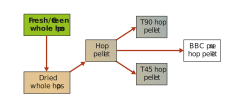
Figure : Overview of hop products and how they are typically derived
The next set of hop products are hop extracts. These are hops which have been extracted using a solvent. Depending on the solvent and process, you can get different extracts for different brewing purposes.