
Lesson 6 - Hop Products
Non-Isomerised Hop Pellets
In this section, we cover the most popular hop products, non-isomerised hop pellets.
T90 hop pellets
This hop product is the most popular of them all. T90 stands for type-90, which means that about 90% of the original bale mass ends up in the pellet. The pellet is made up of hop powder, prepared by milling dried hops. CO2 can be used to help protect the hop contents from oxidation as the lupulin glands are ruptured during milling and pressing.
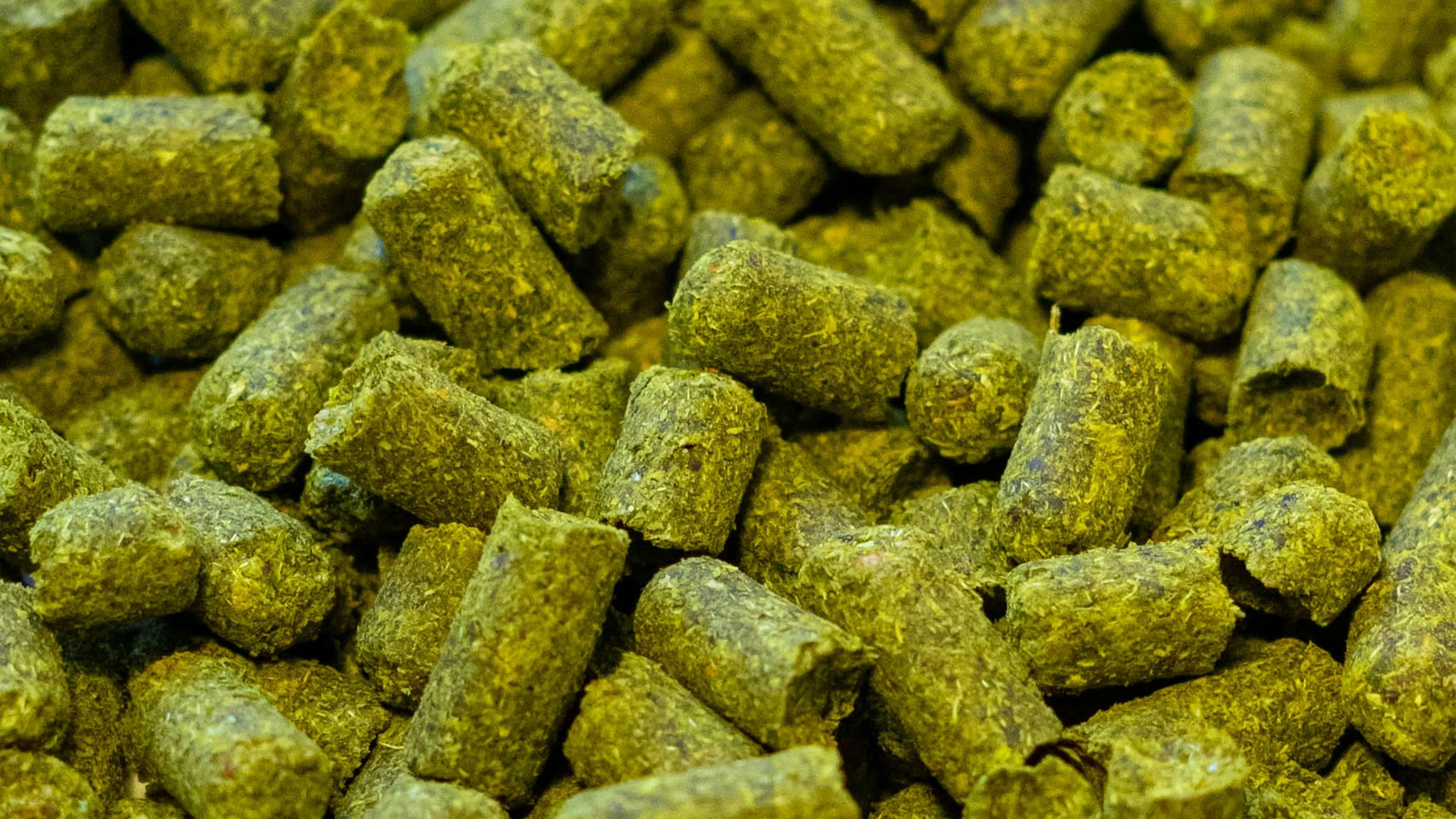
Image courtesy of Charles Faram
Preparation
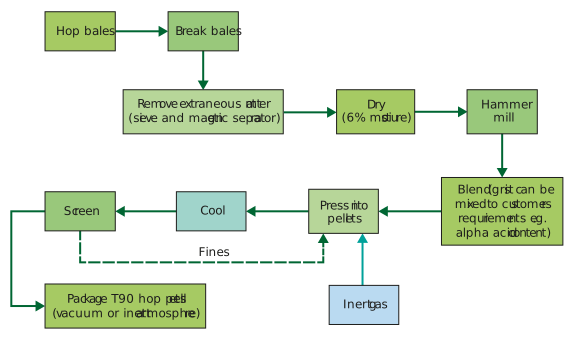
Figure: Production of T90 hop pellets
Application
Can be used for either bittering or aroma.
Point of use
Can be added to the wort kettle during wort boiling, or during fermentation/maturation as a dry hop.
Composition
Table: Average chemical composition of T90 hops
|
Constituent |
Amount (%) |
|
Total resins |
Standardised α-acid |
|
Essential oil |
0.5-3 |
|
Proteins |
15 |
|
Monosaccharides |
2 |
|
Polyphenols (tannins) |
4 |
|
Pectins |
2 |
|
Amino acids |
0.1 |
|
Lipids, waxes and sterols |
Trace-25 |
|
Ash |
8 |
|
Moisture |
6 |
|
Cellulose, etc. |
43 |
Advantages
- Hops of the same variety but with differing α-acid levels can be blended to achieve a standard hop pellet product with a single α-acid level.
- Milling ruptures lupulin glands, making resins and essential oils more accessible (but they can be vulnerable to oxidation if not in an inert atmosphere).
- Pellets break apart in wort/beer and provide a high surface area for extraction.
- Better hop utilisation than whole cone hops (generally 27-32% but can be higher depending on the brewhouse).
- Less vegetative matter resulting in less wort loss.
- Less vegetative matter also means less spent hops to remove; most are removed with the trub when using a whirlpool (this is covered in the wort clarification lessons).
- Still regarded as traditional (no extraction solvents).
- Aids trub formation and settling.
- Easier to store than whole hops. Usually in 5-10 kg bags in inert atmosphere to protect the hops from oxidation.
- Improved handling as pellets are free-flowing – dosing can be automated.
- No need for a hop back but you do need a whirlpool or centrifuge.
Disadvantages
- Can contain pesticide and fertilisers.
- Utilisation, although better than whole hops, is still relatively low.
- Pelletisation process ruptures lupulin glands and therefore they can be prone to oxidation if not protected by an inert gas.
From the list of advantages and disadvantages, it is easy to see why T90 pellets would be preferred to whole hops.
One of the most important advantages is the ability to blend the hops to achieve a uniform α-acid content. This makes it easier for a brewery to consistently hit their bitterness targets. You can also blend different hop varieties together to achieve an aroma profile.
T45 hop pellets
Although we have seen the many advantages of the T90 hop pellet, it remains a relatively dilute source of total resins and essential oils (similar to whole hops).
By chilling and then milling the hops at around -35°C, the lupulin glands lose their stickiness and are therefore easily separated from the vegetative matter. Around 90% of the lupulin can be recovered in less than 50% of the original hop material, doubling the α-acid and essential oil content.
The discarded vegetative matter can be used to standardise hop pellets to a specific α-acid content.
Preparation
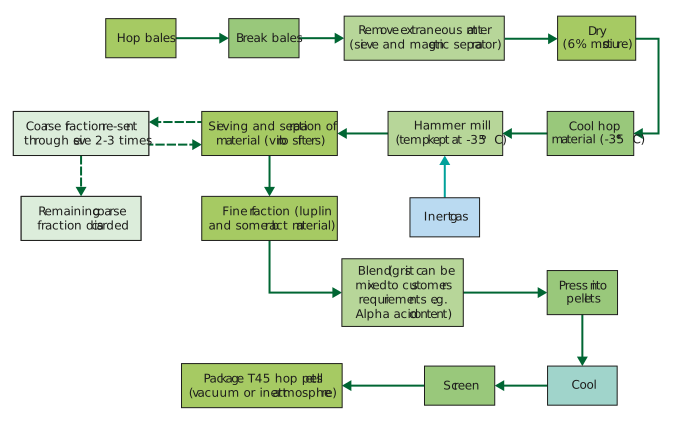
Figure: Production of T45 hop pellets
Application
Can be used for either bittering or aroma.
Point of use
Can be added to the wort kettle during wort boiling, or during fermentation/maturation as a dry hop.
Composition
The resin and essential oil content in T45 pellets is higher (nearly double) that of T90 pellets. Between 50-60% of the vegetative matter is removed.
Point of reflection: If around 50% of the vegetative material of the hops is removed in T45 hop pellets, what do you think would be the main advantages and disadvantages of T45 pellets (compared to whole hops and T90 hop pellets)?
Give yourself 5-10 mins to think about this, then click ‘Next’ to continue with this lesson.