
Lesson 6 - Brewing Product Water Final Treatment
This lesson deals with the various physical and chemical procedures that we can use to treat all water supplied to the brewery. It also examines the processes used to make water potable (if the water supplied to the brewery is not already potable).
We will also explore all additional treatment processes that we can use to prepare water to the correct quality specifications, making it fit for use as brewing product water.
Brewing Product Water
During this lesson and the previous water lessons, we have looked at how raw source water is converted into potable water. We have then explored how it is treated further in the brewery.
This is a good point to run through the entire process again, up to this point:
Pre-brewery water treatment
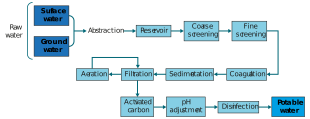
Figure: Pre-brewery water treatment
The raw water has passed through multiple treatment steps to make it potable and free from vegetative microbiological contaminants.
However, we have seen that potable water does not mean brewing product water. We require a further series of treatment steps to make the water suitable for brewing. These steps can vary depending on the brewery and the types of beer produced, but they could include the following:
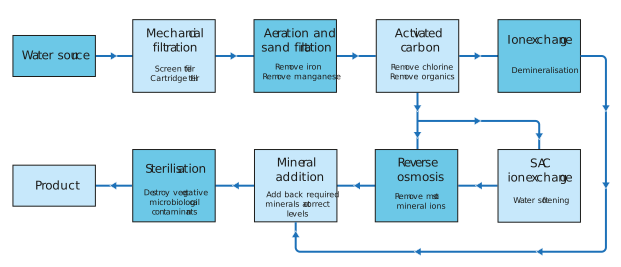
Figure: Brewing product water treatment
At the end of this treatment, the final water can be called brewing product water. It now has the correct alkalinity, mineral levels, total dissolved solids, and is free from vegetative microbiological contaminants.
Once the water specification is achieved, the brewing product water is directed into an ambient water storage tank. The water can be tested for alkalinity, microbiological contamination, pH and target mineral specifications. If the water meets the specifications, the water will then be directed into a hot water tank. From here, it will be used for mashing-in, pushing mash/wort from one brewhouse vessel to the next, sparge water in lautering, lautering underlet water, wort kettle foundation and dilution water. This water will be used throughout the brewing process, wherever water touches product in any way.