
Lesson 6 - Brewing Product Water Final Treatment
This lesson deals with the various physical and chemical procedures that we can use to treat all water supplied to the brewery. It also examines the processes used to make water potable (if the water supplied to the brewery is not already potable).
We will also explore all additional treatment processes that we can use to prepare water to the correct quality specifications, making it fit for use as brewing product water.
Ion Exchange
Ion Exchange
An ion exchange system does “what it says on the box” – exchanges undesirable ions with more desirable ones. Ion exchange systems can remove specific ions or produce completely demineralised water.
Ion exchange uses either polymer resin beads (such as polystyrene or acrylic) or (on rare occasions) naturally occurring zeolites. Each bead is covered in charged functional groups that hold anions (negative ions) or cations (positive ions). The beads are between 0.5 mm and 1 mm in diameter and some are porous and form gels. This means they provide a very large surface area for ion exchange. The resin beads are housed in tanks with a typical bed depth of around 1 m supported on a nozzle plate. This is shown in the figure below.
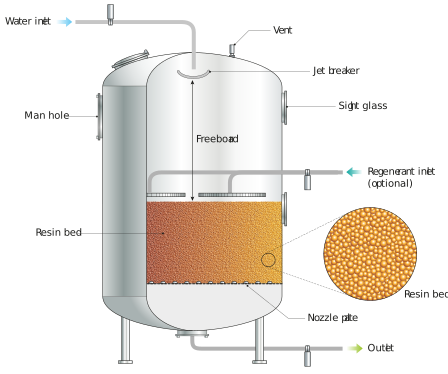
Figure: Ion exchange unit
The size of the beads affects:
- the flow rate of use and regeneration (larger beads = faster throughput)
- the capacity for ions (smaller beads = higher capacity)
- how easily they blind if solids or organic material is supplied to the system (smaller beads = more rapid blocking)
Water flows through the bed of resin beads, where the undesirable ions in the water are exchanged with the desirable ions attached to the functional groups on the resin beads. The desirable ions are called exchange ions. Eventually all the desirable ions will have been used up and the beads’ functional groups are saturated with the ions we need to remove. At this point the resin is regenerated by flushing the beads with a strong solution of the desirable ions. Depending on the exchange (desirable) ions used, regeneration is undertaken with a brine (sodium or potassium chloride), sodium hydroxide or strong acid (hydrochloric or sulphuric acid) solution. It is important that the water used to produce the regenerant solution does not contain the ions that the resin is designed to remove, or the effectiveness of the regeneration will be reduced.
Units can be regenerated in the direction of flow used when in operation (service) or in the opposite direction (counter flow). Counter flow regeneration provides superior deionisation and hence water quality but requires more costly equipment to achieve. Most units can also be backwashed at a faster flowrate to wash off suspended matter coating the resin beads. This is not possible with some counter flow units which can shorten their resin life.
Since the concentration of ions in water determines its conductivity, the effectiveness of the ion exchange unit can be monitored by measuring the conductivity of the water produced. If the units are removing or replacing specific ions then the water needs to be checked for the presence of these ions. The methods used for this are covered in module 2 of the course.
We use four basic types of ion exchange resin in water treatment:
- Weakly acidic cation
- Strongly acidic cation
- Weakly basic anion
- Strongly basic anion
The names of the resins relate to the ions they remove. To help understand these terms, let’s discuss acids and bases in a little more depth.
The Bronsted-Lowry theory of acids states that:
- An acid is a proton (H+ ion) donor.
- A base is a proton (H+ ion) acceptor.
If we take an acid (shown as HA in the example below) and dissolve it in water, the following reaction will occur:
HA + H2O ↔ H3O+ + A-
So, the HA is an acid because it donates a proton to the water (H2O becomes H3O+). The water acts as a base since it accepts the proton from HA.
If the reaction is reversed, the opposite occurs. The H3O+ acts as an acid, as it donates a proton to the A- ion. The  ion is a base as it accepts the proton.
This reversible reaction thus contains two acids and two bases. We call these conjugate pairs:

When HA (acid) loses its proton, it forms A- (base). When A- accepts a proton back, it becomes an acid again, HA. This is a conjugate pair. The strength of an acid or base is how reactive it is, which comes from how willing it is to donate or accept protons. Strong acids like sulphuric and hydrochloric acid love to donate protons, while weak acids like carbonic or carboxylic acid do so less readily. Likewise, strong bases like sodium hydroxide are hungry for protons while weak bases like bicarbonate will accept them less readily. It shouldn’t come as a surprise that the strong acids, that really want to give up protons are very disinclined to accept them and are therefore very weak bases. It doesn’t make sense to accept something you are trying to get rid of!
Back to our resins. Weakly acidic cation resins remove the cations associated with weak acids, (e.g. carbonic and silicic acid). While strongly acidic cation resins remove cations associated with strong acids (sulphuric, nitric and hydrochloric). Weakly basic anion resins remove anions associated with weak bases (strong acids) while strongly basic resins remove those associated with strong bases (the weak acids carbonic and silicic acid).
To muddy the waters somewhat, strongly acidic cation resins and strongly basic anion resins tend to remove all cations and anions respectively. However to justify their name we can think of them as the only resins that will remove strongly acidic cations or strongly basic anions.
The table below lists the pros and cons of the four ion exchange resins.
Table: General pros and cons of ion exchange resin types
|
Ion exchange type |
Abbreviation |
Pros |
Cons |
|
Weakly Acidic Cation |
WAC |
Removes all cations associated with alkalinity (CO3 and HCO3) Only removes temporary hardness, not permanent. High capacity. Efficient use of regeneration chemicals and mildly acidic effluent produced by regeneration. |
Prone to calcium sulphate fouling. Sensitive to chlorine oxidation Only effective in alkaline or neutral water. Regeneration of H+ exchange ion resins involves strong acids (HCl and H2SO4) which are hazardous to store and handle |
|
Strongly Acidic Cation |
SAC |
Operates across entire pH range. Removes hardness (Na+/K+ exchange ion resins) or all cations (H+ exchange ion resins). Long resin life of 10-15 years. |
Sensitive to chlorine oxidation. Sensitive to thermal shock. High sodium output for Na+ exchange ion resins. Regeneration of H+ exchange ion resins can involve strong acids (HCl and H2SO4) which are hazardous to store and handle Prone to iron, calcium sulphate, and aluminium fouling. |
|
Weakly Basic Anion |
WBA |
After cation exchange, they remove chloride, sulphate, nitrate, and other anions of strong acids, but they do not remove weak acids (SiO2 and CO2). Resins are relatively resistant to organic fouling. |
Water produced contains SiO2 (cannot be used for boiler feed water due to scale risk, less of a concern for brewing).
|
|
Strongly Basic Anion |
SBA |
With hydroxyl exchange ions, they remove all anions. With chloride exchange ions, they remove nitrate, sulphate and several other ions. |
Requires strong sodium hydroxide for regeneration if used in hydroxyl form, Relatively short resin life of 2-5 years. |
Let us now look at each ion exchange system in more detail.