
Lesson 6 - Brewing Product Water Final Treatment
This lesson deals with the various physical and chemical procedures that we can use to treat all water supplied to the brewery. It also examines the processes used to make water potable (if the water supplied to the brewery is not already potable).
We will also explore all additional treatment processes that we can use to prepare water to the correct quality specifications, making it fit for use as brewing product water.
Weakly Acidic Cation (WAC) - De-alkalisation
WAC resins only remove calcium and magnesium associated with temporary hardness (bicarbonate) and as a result alkalinity is also removed. This process is known as de-alkalisation. WAC resins have carboxylic acid functional groups.
A summary of how the system works as follows:
The hydrogen (H+) ions are bound to the resin. As bicarbonate rich water passes through it, the resin exchanges its hydrogen ion for a calcium ion. The released hydrogen ion then forms water and CO2. The CO2 is then removed by degassing.
Ca(HCO3)2 + 2 resin-H → (resin)2-Ca + 2H2O + 2CO2
WAC ion exchanger units have a high capacity and are easily regenerated using strong acids such as hydrochloric or sulphuric acid, forming calcium chloride or calcium sulphate respectively. Although strong acids are used, it is possible to limit the amount used to just over the amount theoretically required for regeneration. This means the effluent produced in the treatment process is only slightly acidic.
Regeneration using hydrochloric acid works as follows:
(resin)2-Ca + 2HCl → 2 resin-H + CaCl2
The figure below illustrates the WAC exchange process. Please note, in reality the chemical species exist in water principally as dissociated ions rather than the chemical formulas shown:
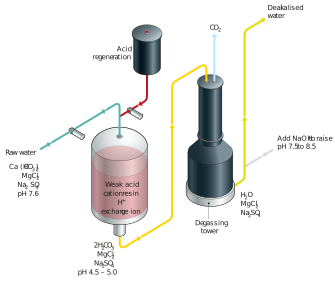
Figure: Dealkalisation by WAC exchange
Water containing hardness ions (made up of both temporary and permanent hardness) enters the WAC. The pH of the water is slightly alkaline. As the water moves through the WAC, the calcium ion is exchanged for a hydrogen ion. The H+ ion addition causes the pH to drop slightly which converts the temporary hardness into carbonic acid H2CO3. The permanent hardness (not removed by boiling) is not removed (shown here as magnesium chloride MgCl2 and sodium sulphate Na2SO4).
The form of the carbon containing ions in water is dependent on the water’s pH. The figure below shows the equilibrium relationship. We can see that at pH below six the vast majority of dissolved carbon is in the form of carbonic acid.
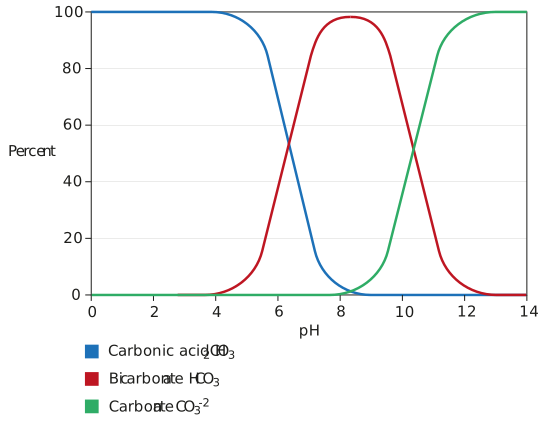
Figure: Graph showing the carbon based alkalinity and pH equilibrium
All the carbon that was alkalinity before WAC is carbonic acid as it leaves the WAC resin bed. The carbonic acid readily dissociates back into CO2 gas and H2O water molecules and the CO2 gas can be removed very cheaply, either via a mechanical aeration gasser tower or using a degasser membrane system. The mechanical aeration degasser tower uses atmospheric air to drive off the CO2 from the water and replace it with oxygen which is known as a sweep gas. If a low dissolved oxygen is required in the treated water, a membrane degasser membrane which uses nitrogen as the sweep gas can be used.
The rate of exchange is determined by the partial pressures of the respective gases so the sweep gas is added in excess to drive off the CO2. The water leaving the degassing tower still contains the magnesium and sodium salts, but the carbonic acid has been converted to water with the removal of CO2. Sodium hydroxide (NaOH) can then added to adjust the water’s pH back to the target value.
The water is now dealkalised, with all temporary hardness (alkalinity) removed.
It is also possible to use sodium as the exchange ion with regeneration using sodium chloride solution. In this form, the resin is also able to remove calcium and magnesium associated with temporary hardness according to this equation:
Ca(HCO3)2 + 2Resin-Na → (Resin)2-Ca + 2NaHCO3
Changing from H+ to Na+ as the exchange ion doubles the volume of the resin so this is not commonly done. Instead we can use a strongly acidic cation exchange resin to remove calcium and magnesium. We discuss these next.