
Lesson 6 - Brewing Product Water Final Treatment
This lesson deals with the various physical and chemical procedures that we can use to treat all water supplied to the brewery. It also examines the processes used to make water potable (if the water supplied to the brewery is not already potable).
We will also explore all additional treatment processes that we can use to prepare water to the correct quality specifications, making it fit for use as brewing product water.
Strongly Basic Anion (SBA)
SBA resins have quaternary ammonium compounds as functional groups and can be used with either chloride or hydroxyl as exchange ions. When using hydroxyl as the exchange ion, SBA resins remove all anions. When using chloride, they remove nitrate, sulphate and several other ions
The reactions in operation and regeneration using each exchange ion are shown below with example anions.
Chloride ion operation: 2 Resin-Cl + SO42- → (Resin)2-SO4 + 2Cl
Chloride ion regeneration: Resin2-SO4 + 2NaCl → 2 Resin-Cl + Na2SO4
Hydroxyl ion operation: Resin-OH + NO3 → Resin-NO3 + OH-
Hydroxyl ion regeneration: Resin-NO3 + OH- → Resin-OH + NO3
When using hydroxyl as the exchange ion, sodium hydroxide is used as the regeneration solution while sodium chloride is used to regenerate the chloride exchange ions. Both are regenerated in a counter flow direction. The use of hydroxyl ions as exchange ions is the most common as it has a broader spectrum of effectiveness. Both exchange ions will remove alkalinity from the feed water but the efficiency is much lower with chloride exchange ions. For this reason SBA resins with chloride exchange ions are seldom used for brewing applications.
There are three types of SBA resins to choose from: Type I, Type II and acrylic. They differ in chemical makeup and, therefore, behave differently. Type I is more effective in removing silica, and is used when the combined silica and carbon dioxide content of the water contacting the exchanger is more than 25% of the total anions. They also help remove total organic carbon from water.
Type I SBA resin degrades to produce amine which has a strong fishy smell so this is unsuitable for beverage applications unless positioned upstream of a cation ion exchanger that can remove the amines. For brewing product water Type II and acrylic SBA resins are typically used.
When using hydroxyl ions as exchange ions, the treated water pH remains unchanged as the hydroxyl ions released neutralise any H+ produced. When using Cl- exchange ions there is a slight pH drop but the leakage of carbonate ions is sufficient to ensure that this is minor. pH adjustment of the treated water may be necessary depending on the ion levels in the feed water.
That covers the four main ion-exchange units. The key points are summarised in the table below:
|
|
WAC |
SAC |
WBA |
SBA |
|
Removes |
Ca²+ and Mg²+ associated with bicarbonate ions in alkaline conditions |
All divalent metal ions at any pH |
Anions of strong acids (e.g. Cl-, SO42- and NO3-) |
Strong and weak acid anions (same as WBA but also H2CO3 and silicates when Cl- is exchange ion) |
|
Exchange ion |
H+ or less commonly Na+ |
Na+, K+ or H+ |
OH- |
OH- (or Cl- but can be limiting) |
|
Produces CO2 |
Yes |
No with Na+ and K+ yes with H+ |
No |
No |
|
Regeneration chemicals |
Strong acids (HCI or H2SO4) |
NaCl, KCI or strong acids (H2SO4 or preferably HCI) |
NaOH |
NaOH or NaCl |
In addition to the stand-alone ion exchange units, it is possible to combine systems – either in a serial system or as a mixed bed reactor.
Serial ion-exchange systems
By putting different ion-exchange units in series, you can remove a variety of ions from the water to achieve various levels of de-mineralisation.
As an example, by putting a SAC and a WBA in series, you can achieve full de-mineralisation (or de-ionised water).
The first stage could be a SAC resin with hydrogen as the exchange ion (replacing all cations with hydrogen ions). Then, the water could flow through a WBA resin, which will replace all the anions (except silica) with hydroxide ions. Alternatively, we could use a SBA resin, which would also remove silica and achieve a full demineralisation.
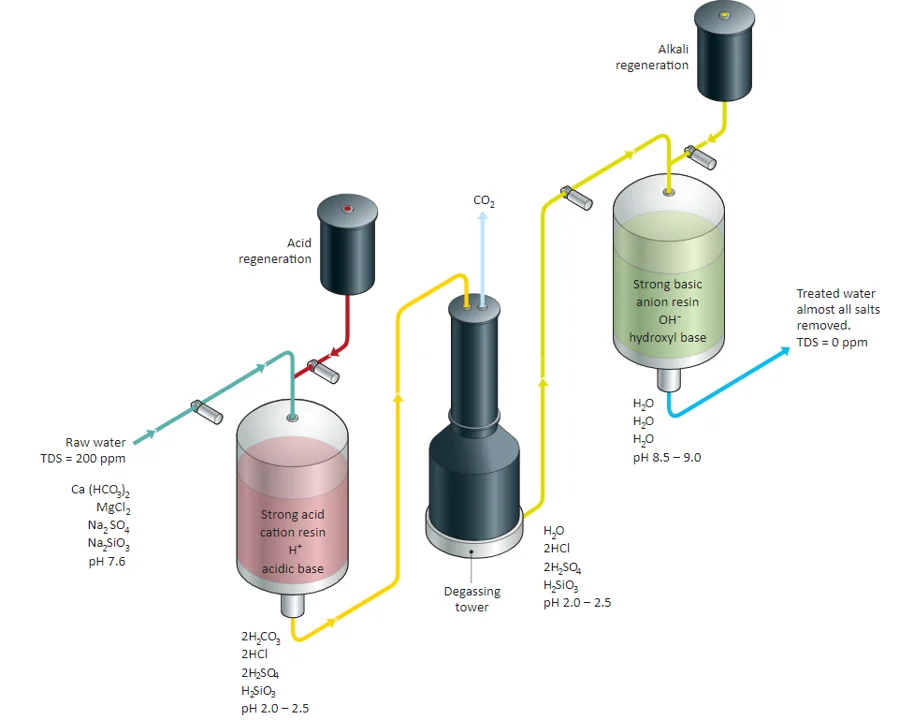
Figure: Full demineralisation using a SAC/SBA system
The figure above shows that this serial system removes the majority of salts to produce essentially mineral-free water.
Mixed bed system
Instead of having two exchange systems in series, we can use a system that contains both SAC (H+ exchange ions) and SBA (OH- exchange ions) resins. The resins can be mixed or layered (stratified). Mixed bed systems should ensure that all ions are replaced with hydrogen or hydroxyl ions, thus forming water. Mixed bed units deliver an excellent treated water quality, but are difficult to regenerate. Resins must first be separated by backwashing before regeneration. Additionally, they require large amounts of chemicals, and the hydraulic conditions for regeneration are not optimal for either resin. Regeneration is with strong sodium hydroxide and a strong acid. The acid is usually hydrochloric acid, as sulphuric acid can form and deposit calcium sulphate. The use of these chemicals can be hazardous and unless neutralised can be environmentally damaging. Due to the difficulties of regeneration and low overall exchange capacity, mixed beds are usually only used to polish pre-demineralised water, where the service run is long.
Feed water quality
Ion exchange systems are designed to produce a specific quality of water from raw water of specific quality. They are able to cope with fluctuations in the ions they are designed to remove but their effectiveness can be impaired or destroyed if the feedwater quality is not maintained. The following water quality parameters will negatively affect ion exchange resins and their performance:
- High levels of free chlorine
- High salinity
- High or low temperatures
- High turbidity (particularly organic substances)
- Excessively high or low pH
Resin selection
The best resin for a particular application is determined by a number a different factors including:
- The composition of the incoming feed water quality
- The desired product water quality
- The availability, price and environmental and safety hazards of regenerant chemicals
- Existing water treatment system infrastructure
- Price of resins
- Nature of effluent produced by the resins