
Lesson 6 - Brewing Product Water Final Treatment
This lesson deals with the various physical and chemical procedures that we can use to treat all water supplied to the brewery. It also examines the processes used to make water potable (if the water supplied to the brewery is not already potable).
We will also explore all additional treatment processes that we can use to prepare water to the correct quality specifications, making it fit for use as brewing product water.
Reverse Osmosis
Osmosis is the diffusion of water across a semi-permeable membrane, from a low solute concentration (more dilute and more water) to a high solute concentration (more concentrated with less water). Osmosis tries to balance the concentration on either side of the membrane – moving water from the side with most water to the side with less water. This results in a more balanced concentration of solutes on either side of the membrane. Therefore, reverse osmosis means that we need to apply enough pressure on the concentrated side, to overcome the osmotic pressure and concentrate the solutes even more.
The membrane pore size can be as small as 0.0001μm. It can filter out most dissolved ions and molecules, except for dissolved gases. Water molecules can pass through the membrane with no problem, thus creating purified water.
The RO typically removes more than 98% of dissolved minerals, but significant pressures of 10 to 20 bar (even up to 82 bar for treating sea water) are required to overcome osmotic pressure.
The membranes are housed within a cartridge, and the water flows alongside the membrane. The filtered water (permeate) leaves the filter one way and the contaminated water (concentrate) goes another way. This is shown in the figure below:
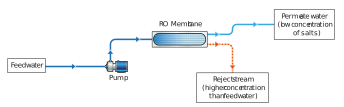
Figure: Principle of Reverse osmosis filtration
The feed water is pumped in at high pressure (to overcome the osmotic pressure) and the water molecules pass through the membrane. This water is known as the permeate (the demineralised water, or product water). The minerals are stopped and remain in the rest of the water. This is known as the reject stream or concentrate. This concentrate is then either sent to drain, or is fed back into the feed water supply, to minimise water loss. Some ROs have additional membranes to process the concentrate hence reducing the volume of water rejected.
The flow of water alongside the membrane minimises mineral build-up on the membrane as the water sweeps away the minerals. It also produces turbulence to help keep the membrane surface clean.
There are many advantages to RO. These include:
- Alkalinity and problem compounds such as manganese, silicates and iron are removed.
- It provides blanket removal (reduction) of everything dissolved or suspended in the water.
However, there are also disadvantages:
- The concentrate is difficult to dispose of if the mineral level exceeds the local wastewater limits.
- The reject rate on most RO units is around 25% of feed water volume meaning water use is dramatically increased.
- Membrane replacement is expensive.
If the feed water is hard, it is best to have an ion exchange unit before the RO. This reduces the load on the RO membranes, thus preventing carbonate scale and other elements from fouling the membranes. Anti-scalent dosing can also be used to prevent silica and hardness scale blocking membranes. It is also normal to have a membrane filter before the RO to remove suspended solids that could block the membranes. An activated carbon filter is also required if the feed water is chlorinated as chlorine can damage the membranes.
The main advantage of RO is that the feed water is converted to virtually pure water. The composition of the water can then be adjusted to achieve any water specification required. This is often done by blending it with untreated water. Being able to precisely adjust the water composition enables us to brew any type of beer