
Lesson 6 - Brewing Product Water Final Treatment
This lesson deals with the various physical and chemical procedures that we can use to treat all water supplied to the brewery. It also examines the processes used to make water potable (if the water supplied to the brewery is not already potable).
We will also explore all additional treatment processes that we can use to prepare water to the correct quality specifications, making it fit for use as brewing product water.
Removing Organic Contaminants
Activated carbon is probably the most popular and recommended method for removing chlorine and most organic contaminants from water.
With the exception of reverse osmosis, treatments that reduce hardness, or a water’s mineral content, are usually unable to remove organic or halogen contamination. Halogen compounds react with organic material (either from the water or beer) to produce organic halogenated compounds such as trihalomethanes (THMs) and chlorophenols. These may give colour, taste or odour to water and beer.
The most effective treatment is adsorption on porous material.
Activated carbon (based on coal or coconut) can adsorb impurities from water through physical adsorption into its honeycomb structure. This is a reversible process. The carbon usually has high internal pore volumes, which provides a large surface area for adsorption.
Activated carbon has a finite capacity to adsorb chemicals, and require replacement or regeneration depending on the level of contamination and the capacity of the filter used. The removal of chlorine from water renders it susceptible to microbial infection and carbon filters usually require steam sterilisation at regular intervals.
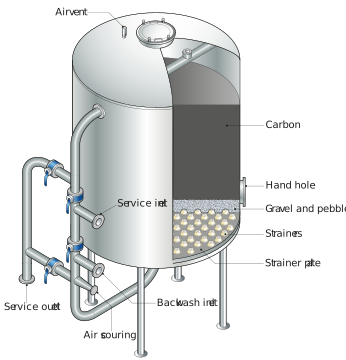
Figure: Diagram of an activated carbon filter
Chlorine removal by metabisulphite
Sodium metabisulphite or potassium metabisulphite reacts with water to form sulphur dioxide:

The sulphur dioxide then reacts with chlorine to form chloride and sulphate:

Chlorine removal by UV degradation
A modern method uses UV photolysis. UV light at 180-200 nm breaks the chlorine’s molecular bonds, reducing it into its component ions, yielding chloride and water. The UV light has the added benefit of killing 99.99% of bacteria and viruses.
This leads us into the final section – water sterilisation (without chlorine).