
Lesson 6 - Brewing Product Water Final Treatment
This lesson deals with the various physical and chemical procedures that we can use to treat all water supplied to the brewery. It also examines the processes used to make water potable (if the water supplied to the brewery is not already potable).
We will also explore all additional treatment processes that we can use to prepare water to the correct quality specifications, making it fit for use as brewing product water.
Removing Dissolved Solids by Filtration
We have mentioned filtration previously. Historically, filtration systems dealt mainly with larger molecules. This ranged from removing large objects through steel grates, to cartridge filters that removed fine and micro-particles, as well as macromolecules (depending on the filter used).
The next level of filtration is usually membrane filtration. This uses a semi-permeable membrane, which allows certain ions, molecules, particles etc. through. It retains (stops) others from passing through, depending on the filter pore size.
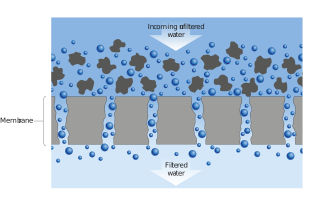
Figure: Principle of membrane filtration
The size of filter pore in the membrane determines filtration levels. These levels can range from microfiltration to reverse osmosis.
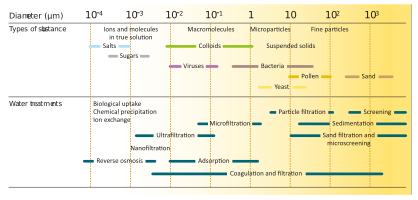
Figure: The size of dissolved, suspended and colloidal matter, and their associated water filtration requirements
As you can see from the figure above, microfiltration removes particles down to about 0.1 micrometres (μm). This removes yeast cells, small suspended solids, large colloids and most bacteria. Due to the size of the filter pores, they do not remove dissolved substances.
For normal brewing practices, this level of filtration would suffice. In fact, sterile filtration used in packaging uses 0.45μm filters. These filters operate at a pressure of about 0.7-4 bar.
Ultrafiltration
The next membrane technology is ultrafiltration. This typically performs 10 times better than microfiltration, with a filter pore size down to 0.01μm. At this pore size, most viruses are removed as well as colloids and large organics (such as protein). However, it will still not remove dissolved substances, or change the water’s chemical characteristics (e.g. no de-mineralisation). These filters operate at a pressure between 2-7 bar.
The next two filter membrane technologies actually purify the water, due to their incredibly small filter pore size.
Nanofiltration
Nanofiltration achieves 10 times more than ultrafiltration. It filters down to 0.001μm or 1 nanometre (nm). At this pore size, most organics are removed [including the precursor to trihalomethanes (THM)]. 20-80% of dissolved salts are removed, thus the filter starts to de-mineralise and dealkalise the water. The pressure required to operate a nanofiltration system is significant, with pressures between 6-10 bar.
The ultimate in membrane filtration is reverse osmosis (RO).