
Lesson 6 - Brewing Product Water Final Treatment
This lesson deals with the various physical and chemical procedures that we can use to treat all water supplied to the brewery. It also examines the processes used to make water potable (if the water supplied to the brewery is not already potable).
We will also explore all additional treatment processes that we can use to prepare water to the correct quality specifications, making it fit for use as brewing product water.
Strongly Acidic Cation (SAC)
SAC removes all metal cations including the calcium and magnesium ions bound to bicarbonates at any pH. SAC resins have sulphonic acid functional groups. SAC resins with Na+ exchange ions are used in domestic water softeners.
Sodium (Na+) ions or hydrogen (H+) ions are used as the exchange ions. Regeneration of the resins is undertaken using brine or strong acid solutions respectively.
The equations for the two processes are shown below:
2 resin-Na + (metal ion)2+ → (resin)2-metal ion + 2Na+
2 resin-H + (metal ion)2+ → (resin)2-metal ion + 2H+
If using H+ as the exchange ion, SAC removes cations in the order of affinity shown below:
Fe > Ca > Mg > K > Na > H
The SAC with H+ ions also forms acidic compounds – for example, NaCl (sodium chloride) becomes HCl (hydrochloric acid). The water pH will thus drop significantly after the SAC, typically to around pH 2.5 - 3.5. As a result carbonate ions are converted to carbonic acid which dissociates into CO2 and water and can be removed using a degassing tower or membrane degasser.
If sodium is the exchange ion, the water passes through the resin, exchanging all divalent metal ions (mainly Ca²+, Mg²+, Fe²+ and Mn²+) with Na+. The pH of the water leaving the resin does not drop to the same extent as when H+ is the exchange ion so carbonate and bicarbonate ions are not converted to carbonic acid.
Depending on the final Na+ levels in the water, it may be necessary to use reverse osmosis, to reduce the sodium content going into the brewing product water. In fact, if the water is high in calcium hardness, SAC is often used upstream of a reverse osmosis unit to prevent the calcium from scaling up its membrane.
The figure below follows a similar process to the one explained in detail for the WAC. The key difference here is that magnesium chloride is also removed, and bicarbonate is not.
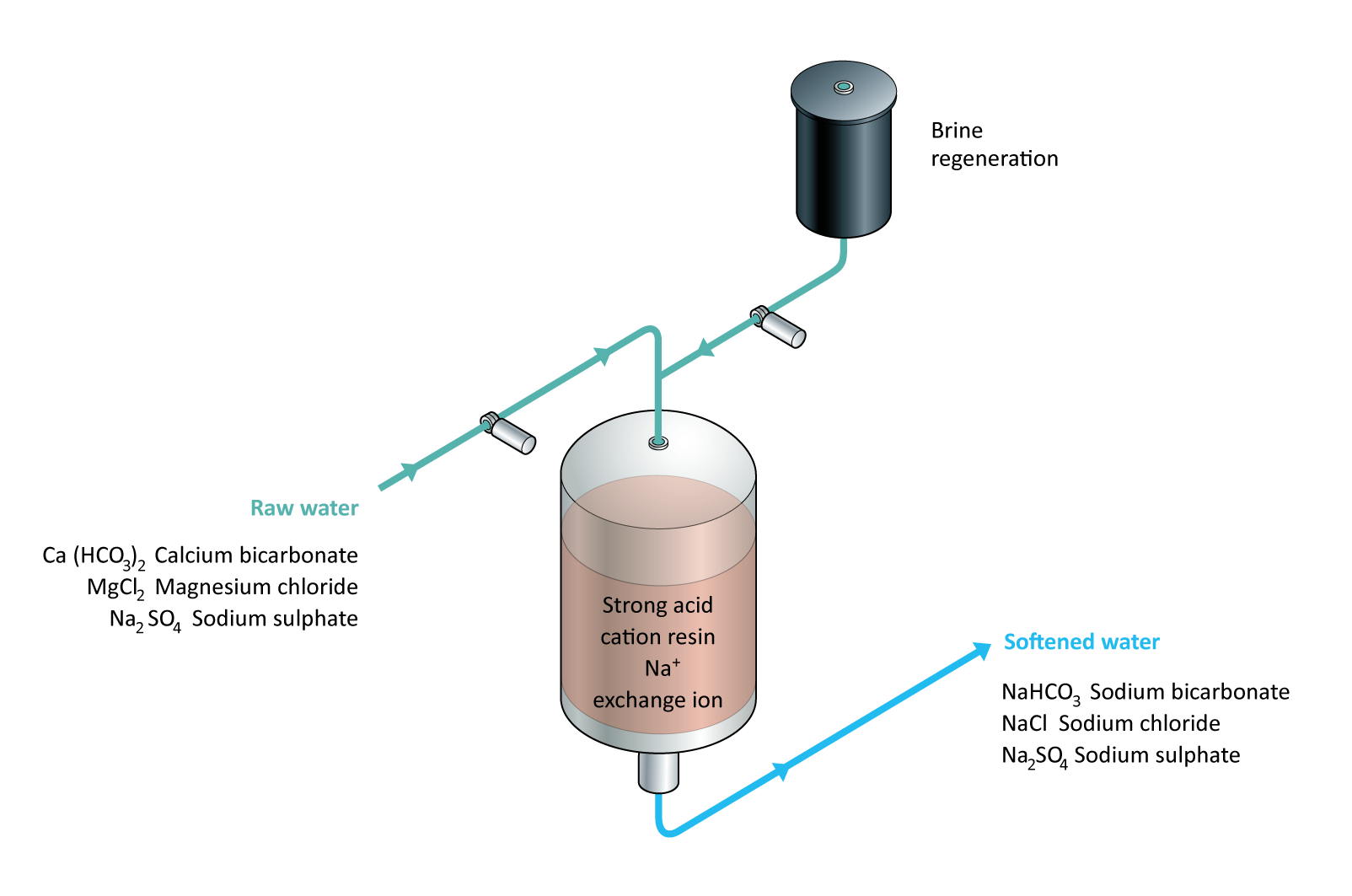
Figure: Strong Acid Cation exchange system for water softening
If the resin had been regenerated with KCl the sodium compounds shown on the outlet would be the equivalent potassium compounds. Since bicarbonate is not removed (and due to the high sodium or potassium), unless the water is treated with reverse osmosis, it is likely that the water will be unsuitable for product water. it can however be used as process water for bottle washing/CIP and service water for use in steam raising.