
Lesson 6 - Brewing Product Water Final Treatment
This lesson deals with the various physical and chemical procedures that we can use to treat all water supplied to the brewery. It also examines the processes used to make water potable (if the water supplied to the brewery is not already potable).
We will also explore all additional treatment processes that we can use to prepare water to the correct quality specifications, making it fit for use as brewing product water.
Removing Solids from the Base Product Water
Although the municipality remove most of the solid material from water delivered to the brewery, some new suspended solids could have entered the water. Furthermore, we may need to remove some dissolved solids, so that the water is suitable for brewing.
During pre-treatment by the municipality, the raw water passed through a series of mechanical filtration steps, such as screening through metal grids and sand filtration. These filtration steps would have removed large solid objects, organic contaminants, algae and some other micro-organisms. However, as the water leaves the municipality, it is possible for solids to re-contaminate the water, especially if the water is kept in a storage reservoir.
Mechanical filtration
At this stage of the process, a brewery only needs a relatively small filter, such as a cartridge filter, to remove any remaining suspended solids. Cartridge filters usually consist of polymer fibres, which are wound in a spiral to create a matrix that traps solid particles. Alternatives are filters made up of sand granules, or even flat sheet filters.
In all cases, the principle is the same – create a medium that water molecules can pass through, but add in channels, which are too small for solids to enter. The solids are then trapped on the medium’s surface.
Over a period, the solids begin to block up all available channels, making it difficult for the water molecules to find a route through. This causes the pressure over the filter medium to increase between the filter’s inlet and outlet points. This indicates that the filter should be replaced or cleaned/regenerated for re-use.
The figure below illustrates the process:
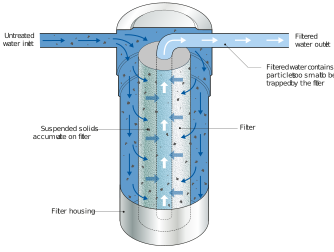
Figure: Removal of suspended solids in water via a cartridge filter
Some solid particles are too small to be trapped by the filter and will need to be removed by a final filtration step – more on that later!
Removal of iron and manganese
We have previously mentioned that iron and manganese can be detrimental to final beer quality, as they cause flavour and colloidal instability by catalysing oxidation reactions. They can also create metallic off-flavours. Although manganese can act as a co-factor to yeast enzymes, higher levels of manganese and iron can negatively affect the yeast, causing incomplete fermentations. They can also be detrimental to the brewing plant, causing corrosion in boiler systems and heat exchangers.
Both metals are removed as part of the pre-treatment process. This is followed by the municipality’s treatment process. However, since small amounts of these ions can negatively affect the beer and equipment, the brewer will want to remove as much of them as possible. A further removal process is recommended on site.
Speciality filters using catalytic media such as manganese dioxide or greensand can remove both iron and manganese from the water.
Removal of iron
We can inject air or ozone directly into the water. This causes the iron to oxidise to insoluble oxides and hydroxides. These then precipitate and can be removed via filtration. Alternatively, we can leave them to settle to the bottom of a tank, and then physically clean them out.
Another option is to dose the water with phosphoric acid which causes the iron to bind with the phosphates. This iron phosphate is insoluble and can be filtered or precipitated out of the water.
Removal of manganese
Manganese does not oxidise readily; it needs a stronger oxidising agent, such as chlorine. Manganese oxide forms hard deposits, which are incredibly difficult to remove and can cause pitting of steel.
We can effectively remove them using greensand filtration, which is a granular-media system containing glauconite. Glauconite is a mineral that uses oxidation to reduce the level of manganese, hydrogen sulphide and iron. Once the oxidising capability of the filter is exhausted, we can regenerate it using a potassium permanganate solution.
Another system that removes both iron and manganese is an ion-exchange system. We commonly use this system to remove dissolved solids from the water [see the section titled Strong Acid Cation (SAC) later in this Lesson].
Reduction of alkalinity
Water with very high alkalinity levels is not suitable for brewing with; the brewer will generally strive to reduce the water’s bicarbonate levels.
Some simple methods are available; we still use some of them today.
Decarbonation by heating
This method is rarely used today as it has high energy requirements. Think of your kettle at home. If the water is particularly hard, you will notice scale formation in the kettle. This scale is insoluble calcium carbonate (CaCO3), which is formed as follows (when heat is applied):
Ca(HCO3)2 ↔ CaCO3 + CO2 + H2O
The bicarbonate is converted to calcium carbonate (which precipitates out of the solution) and carbon dioxide is released. We do not need to boil the water in order for the reaction to occur. Water temperatures above 70˚C should start to show signs of scaling.
Decarbonation by treatment with lime
A saturated lime solution (calcium hydroxide) is dosed into the water and stored in a vessel. The calcium hydroxide and bicarbonate react to form lime scale (calcium carbonate), which precipitates out and settles to the bottom of the vessel.
Ca(HCO3)2 + Ca(OH)2 → 2CaCO3 + 2H2O
Carbon dioxide is not formed, but the water may need to be filtered to remove any suspended solids.
This method is relatively cheap, and the process also precipitates iron, manganese and other heavy metals.
The amount of lime added will need to be adjusted according to the amount of bicarbonate in the incoming water.
Decarbonation by acid addition
Inorganic or organic acid is added to the water, which reacts with the bicarbonate to release carbon dioxide and form calcium.
Ca(HCO3)2 + 2H+ → Ca2+ + 2CO2 + 2H2O
Although we still use these systems today, modern treatment options are now available. They allow multiple treatments to occur, as opposed to just removing carbonates. These treatments include ion exchange and membrane filtration.