
Lesson 6 - Malt Quality
This lesson deals with malt quality. We explore each parameter on a malt specification sheet and identify why they are specified. We then examine how they affect beer and the brewing process.
Protein
Proteins unlike most carbohydrates and lipids contain nitrogen. Malt suppliers use the terms protein and nitrogen interchangeably.
Total nitrogen
Total nitrogen (TN) analysis measures both the soluble and insoluble nitrogen in the malt sample. To convert between the two we can use this equation:
Total protein = 6.25 x total nitrogen
In general, malt made from six-row barley contains higher total nitrogen than two-row; this often results in higher enzyme activity.
Total nitrogen by the Kjeldahl method
The Kjeldahl method was developed by Johan Kjeldahl in 1889. To undertake the Kjeldahl method (also called Kjeldahl digestion) finely milled malt is transferred to a special digestion flask and heated with concentrated sulphuric acid, plus a catalyst such as mercurous sulphate or copper sulphate. The nitrogenous compounds in the wort are transformed into ammonium sulphate. The digest is then cooled and treated with sodium hydroxide solution which releases ammonia gas from the ammonium sulphate. The ammonia gas is bubbled through boric acid which forms ammonium borate. The ammonium borate is then titrated with a strong acid of known concentration with Tashiro’s indicator to establish the concentration of ammonia.
TN is then calculated from the concentration of ammonia determined by the titration. The test is validated by replacing malt with a solution containing a known nitrogen concentration and checking the result. The apparatus required for the method is shown below.
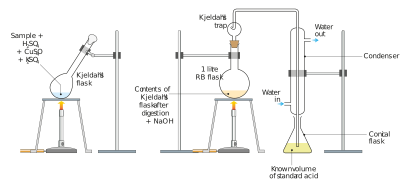
Figure: Diagram of Kjeldahl method
Today the process is often automated. Here’s a fascinating video showing it in action.
Total nitrogen by Dumas combustion
As its name suggests, Dumas combustion involves combusting milled malt in a chamber in the presence of oxygen at around 1000°C. The non-nitrogenous products of combustion (CO2 and water) are passed over columns for selective absorption. Once these are removed, the oxides of nitrogen produced are chemically reduced to nitrogen using copper based catalysts. In another version of this method, chromatography is used to separate CO2 and oxides of nitrogen. For both methods the amount of nitrogen liberated is then measured by a thermal conductivity detector. As with the Kjeldahl method the system is calibrated using as standard sample of known nitrogen content and today is generally undertaken by machine. Here’s a video.
.Total soluble nitrogen (TSN)
The sample is prepared by doing a Congress mash. The EBC fine grind method is used. These samples are then analysed as per the Kjeldahl or Dumas methods, to determine the soluble fraction of proteins.
TSN results are not only used on their own, but also in relation to the total nitrogen.
Further reading: Take time and research soluble nitrogen ratios or Kolbach index (KI) values for malt sold in your area or country. Some companies set their pale malt KI specification between 38-45%.
Free amino nitrogen (FAN)
Barley protein is broken down to amino acids (FAN) to a limited extent in malting but most of the FAN in wort is produced during mashing. Peptidases break down peptides to form amino acids, which are required by yeast during fermentation.
Wort FAN levels reflect the nitrogen level in the barley to an extent, with higher nitrogen barley having a higher FAN. However it is not a direct relationship.
Below are some example FAN levels from worts produced by standard IoB and EBC (Congress) mashes:
Ale malt 110-135 mg/L using IoB method
Pale malt 125-170 mg/L using IoB method
Pale malt 135-190 mg/L using EBC method
There are two methods for estimation of FAN in wort by spectrophotometry. In the ninhydrin method, the wort is diluted and added to a tube along with a staining reagent containing ninhydrin. The tube is stoppered and immersed in a boiling water bath for 16 minutes at a pH of 6.7. The ninhydrin reacts with amino acids to produce a yellow colour. The tube is then removed and cooled to 20°C for 20 minutes. The sample is then diluted and the absorbance at 570nm is measured with a spectrophotometer in a 10mm cell. A blank made with water in place of the diluted wort is used to measure the absorbance of the reagents without the wort.
A spectrophotometer is a device which shines a light of a specific wavelength through a sample and measures the amount of light which has passed through it. The amount of light which is absorbed can be determined by subtracting the amount measured from the amount shone on the sample. This is of course a very basic explanation. A more detailed one can be found here.
The result is calculated by multiplying the absorbance of the sample by 2 and the dilution factor and then dividing by the absorbance of the blank. The reason this method is referred to as an estimation is that γ-aminobutyric acid, ammonia and imino acids which are present in both wort and beer stain strongly with ninhydrin and contribute to a higher result.
The other method uses 2,4,6-trinitrobenzene 1-sulphonic acid (TNBS). TNBS stains amino acids orange. In the TNBS method the sample is added to a TNBS solution and incubated at 37°C for 2 hours. Sodium dodecyl sulphate and hydrochloric acid are then added to the sample and the absorbance at 335nm is measured.