
Lesson 6 - Malt Quality
This lesson deals with malt quality. We explore each parameter on a malt specification sheet and identify why they are specified. We then examine how they affect beer and the brewing process.
Physical Attributes
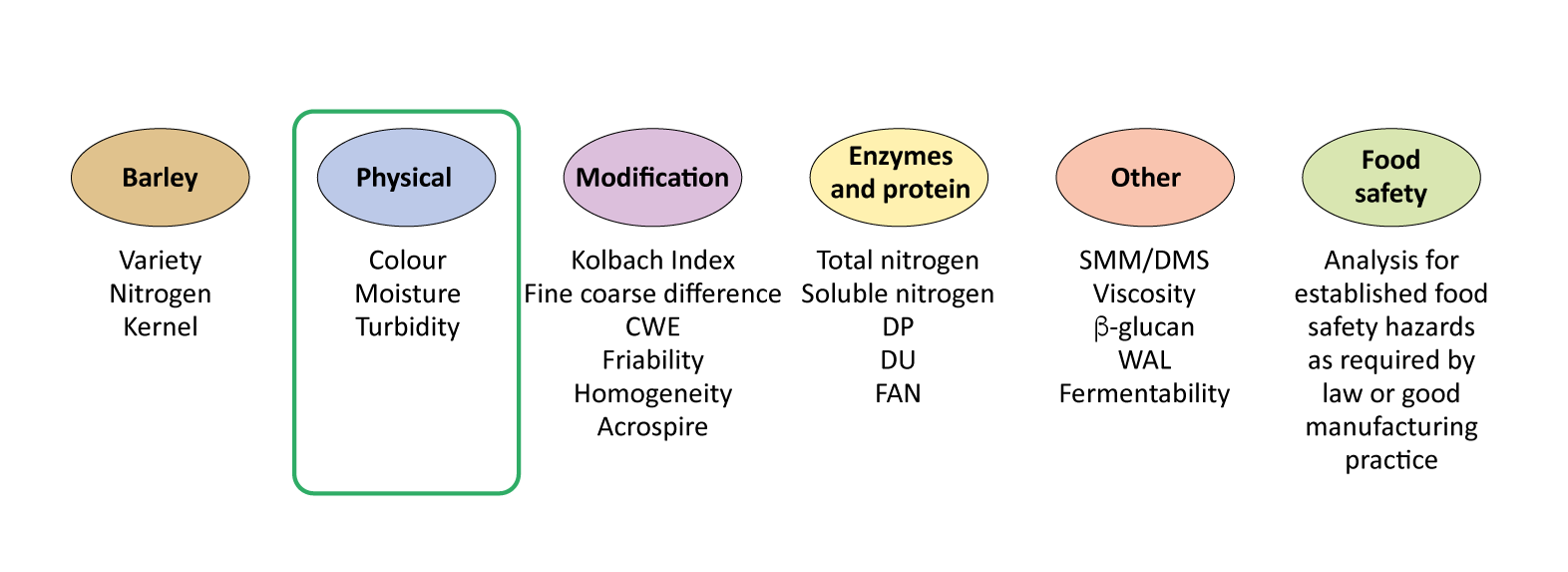
Colour
The correct malt colour is very important, particularly if no additional colouring is added as part of the brewing process. The golden rule is that you can always add colour, but you cannot take it out!
Malt colour is produced in the Maillard reaction. The Maillard reaction starts with a reaction between amino groups and reducing sugars and produces a diverse range of coloured and flavoursome compounds. The optimum temperature for the Maillard reaction is 140 - 160°C, so up to this temperature the hotter the kiln, the darker the malt. Highly modified malts have higher concentrations of amino groups and reducing sugars so gain colour more readily during kilning.
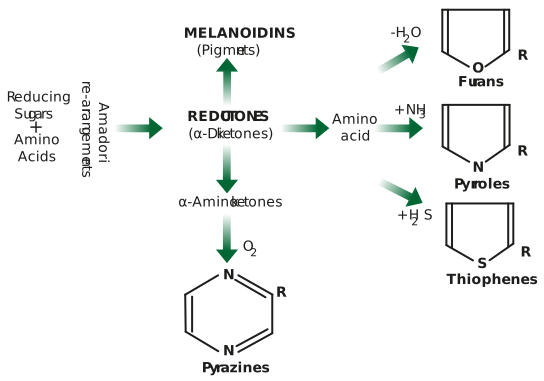
Figure: The Maillard reaction
Colour measurement
Two main methods are used to measure colour. Both involve measuring the absorption of light at a wavelength of 430 nm by a wort sample in a spectrophotometer. The sample comes from a standard mash.
The EBC method uses a 1 cm glass cell while the Standard Reference Method (SRM – published by the ASBC) uses a half-inch cell. There is also a third unit of colour called ˚Lovibond (˚L), which is very close to SRM for all except very dark colours. Fortunately, it is easy to convert between these units of measurement:
Note that for both these measurements, the unit of measurement is just EBC/SRM and not degrees EBC.
EBC = SRM x 1.97
SRM = EBC x 0.508
SRM = (1.3546 x ˚L) – 0.76
Moisture
Malt moisture is one of the most important parameters on the certificate of analysis. Malt moisture is important for economic and quality reasons.
Firstly, the economics. Malt is sold by weight. So, if we are paying for a high moisture content malt, we are paying for more water than we would if the moisture was at the correct level. If a 27 t load of malt is 1% moisture above the specification we are paying for 270 kg of water with our malt! If we didn’t identify the problem on receipt of the malt our extract efficiency in the brewhouse will be 1% lower than expected.
We must also consider the quality reasons for having the correct malt moisture:
- If the moisture content is too low, the malt is likely to break as it is moved around the brewery. This will result in high levels of dust and losses. It may also give a finer than desired particle size distribution when milled.
- If the moisture content is too high, the malt is likely to spoil during storage due to microbial growth or infestation. This can result in the malt becoming unusable or beer quality problems. Also, malt with a high moisture content generally does not shatter sufficiently in the mill, resulting in low extract yields in the brewhouse.
Specifications for malt moisture range from 4-6%. Most brewers specify 4% as a target. Moistures above 6% can give rise to the problems detailed above.
Malt must be stored in a cool, dry environment. If not, it generally absorbs moisture from the atmosphere. This can lead to spoilage, poor processing and beer quality problems.
Slack malt
This is an old British term for malt that has been allowed to pick up moisture and as a result has gone slack. Slackness can manifest itself as off flavours, low enzyme potential, difficulty in processing and poor extract and beer flavour. If you get your job right, you won’t ever have to use the term!
Moisture measurement
A milled malt sample is weighed and placed in a calibrated oven for a specific time. The mass difference before and after drying can give you the moisture content.
Typical method:
- Mill at 0.2 mm until you have a fine grind.
- Use metal moisture dishes with tight fitting lids.
- Put in the oven at 105-106˚C (± 0.5˚C) for 3 h (± 5 min).
The samples must be cooled to room temperature in a desiccator for 20 min.
Formula:

Where:
m1 = mass in g of sample before drying
m2 = mass in g of sample after drying
Moisture can also be determined by near infrared (NIR) absorbance spectroscopy.
Turbidity
The wort produced by a Congress mash should be quite bright. High protein or β-glucan levels resulting from poor modification can cause hazes in wort. These indicate that wort made from the malt may negatively affect brewhouse operations, filtration and potentially beer clarity. On malt analysis reports, turbidity can simply be reported as clear or slightly hazy. Some suppliers measure turbidity with a haze meter and report the results as NTUs (Nephelometric Turbidity Units) or EBC haze units.