
Lesson 6 - Malt Quality
This lesson deals with malt quality. We explore each parameter on a malt specification sheet and identify why they are specified. We then examine how they affect beer and the brewing process.
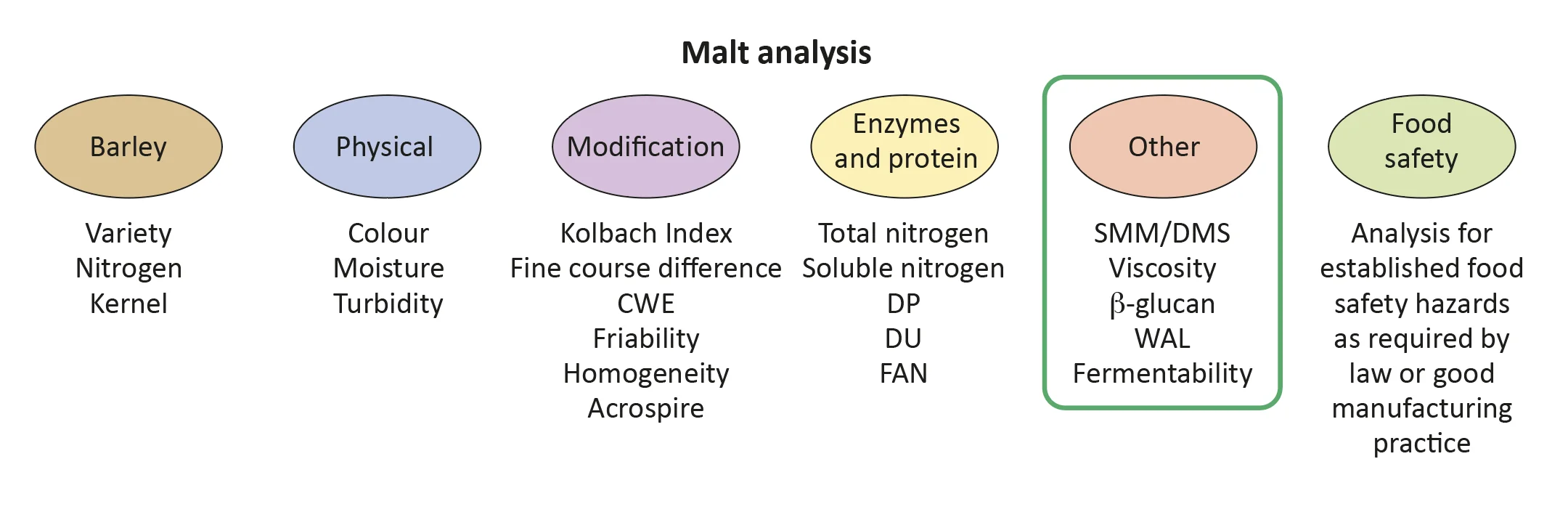
Other Analyses
Dimethyl sulphide (DMS)
DMS is an important, and sometimes unwanted, beer flavour compound.
It is measured using a gas spectrometer. Free malt DMS is measured by incubating milled malt in a tube at 35˚C for 30 min. The headspace (the area above the malt) is analysed. The total malt DMS is measured by degrading the precursor SMM to DMS using a caustic solution and incubating at 50˚C. The SMM values are calculated by subtracting the free DMS value from the total DMS value. The values are reported as µg/g.
In our malt specification, we should set the level of DMS/SMM to one that provides the target level of DMS in the beer after the brewing process. For most beers this value is below its flavour threshold.
Viscosity
High viscosities in wort separation, whirlpool operations and beer filtration cause problems. Viscosity is the resistance of a fluid to a change in shape. It is measured using a viscometer, which measures how long a set volume takes to flow through a capillary. The results are expressed in units of centipoise (cP); the lower the cP, the better. Values should be below 1.60 cP, results lower than 1.5 cP are even better!
Key Point:
Viscosity is sometimes reported in mPa.s (milliPascal.seconds) on an analysis sheet. The values are the same in both units.
β-glucan
Malt’s β-glucan content is of great importance. β-glucan causes problems in wort separation and beer filtration. The amount in the malt depends on the levels in the barley and the degree of modification.
β-glucan analysis is undertaken on the standard wort with calcofluor (that we met earlier) using flow injection analysis. In flow injection analysis the wort is pumped through a tube and calcofluor is injected inline to bind to the β-glucan in the wort and fluoresce. The mixture of wort and calcofluor then flows through a mixing coil before passing a Fluorescence detector, with a fluorescence lamp giving light of 360 nm and emission measured at 425 nm. The concentration of β-glucan is calculated from the amount of fluorescence measured. Another method using a micro titre reader is also available but less common.
Malt β-glucan levels should ideally be below 150 mg/L. Many breweries set the limit at 100 mg/L.
Wort attenuation limit (WAL) and fermentability
Most yeasts used in commercial brewing can only ferment mono, di and trisaccharides. A typical wort is around 75% fermentable, so 75% of the wort by weight will be these sugars. To determine how fermentable a wort is, we undertake a wort attenuation limit (WAL) test (also called a limit attenuation and limit extract).
The word attenuate means to make thin or weak, and in brewing, we use it to describe the reduction in the gravity or extract in the wort by yeast.
In a WAL test, wort is added to a flask with 7.5 g/100 mL of compressed yeast. The flask containing the wort and yeast is then kept warm and shaken to enable the yeast to consume all the sugar in the wort. This accelerates fermentation so we can get an idea of the fermentability of the wort in the lab before it has fermented in the brewery. The test is complete when the gravity of the wort ceases to fall. The gravity at this point is called the attenuation limit.
The gravity before and after the WAL test is measured, and from this, we can calculate the percentage of apparent attenuation.

OG = original gravity of wort added to flask
PG = attenuation limit test gravity
We use the word apparent because the yeast converts most of the sugar to ethanol. The gravity of ethanol is lower than that of water, so the drop in gravity is actually greater than it would be if solely caused by the reduction in the concentration of sugars. We can apply a factor to roughly account for the difference in gravity caused by the increase in ethanol. Once we have done this, the figure is called the percentage real attenuation and is the percentage fermentability of the wort. Here’s the calculation.

So, for a congress wort with an OG or 11°P and a WAL gravity of 1.2°P we would calculate the percentage real attenuation like so


In this context the term attenuation has the same meaning as fermentability. The percentage fermentability of the wort made from our malt is the same as the percentage attenuation achieved by our yeast. So the same calculations are used to calculate % fermentability.