
Lesson 6 - Malt Quality
This lesson deals with malt quality. We explore each parameter on a malt specification sheet and identify why they are specified. We then examine how they affect beer and the brewing process.
Modification Analyses (continued)
Friability
Friability is how easy it is to crush the malt. We measure 50 g and place it into a friabilimeter. Inside the friabilimeter, the malt rotates in a slotted wire drum sieve for eight minutes with a light roller set over it. The malt breaks up and the crushed malt passes through the sieve. The crushed material which has passed through the sieve is weighed and compared to the 50 g we started with, as a percentage. This provides an indication of how modified the endosperm is. The video below shows a friabilimeter in action.
Friability can also be assessed by the kernels’ mealiness. Fifty grains are placed into a special holder, cut in half, and visually assessed and classified as follows:
- mealy (soft and flour-like, indicating good, even modification)
- half-glassy (hard ends, reflecting partial modification)
- glassy (where 75% of the endosperm is hard and unmodified).
These numbers are reported on malt analysis sheets as a percentage of each classification e.g. 95%, 4%, and 1%.
Homogeneity
Following the 50 g friability test, there are normally some part or whole grains of malt left on the roller sieve. These are sorted and any corns that are between three-quarters whole and completely whole are removed and weighed and the weight multiplied by two; this is the percentage glassy corns or wholly unmodified grains (% WUG).
With the WUG added back, the residual material from the friabilimeter drum is placed onto a 2.2 mm sieve and shaken for one minute. The material which has not dropped through the 2.2 mm sieve is then weighed. Multiplying this weight by two gives the percentage partly modified grains (% PUG). Subtracting % PUG from 100 gives the percentage homogeneity.
Acrospire growth analysis
This analysis is typically conducted during germination, to determine whether the grains are growing at the correct rate. It can also be included in the CoA as an index of modification. Although this is uncommon.
Kernels are boiled in a copper sulphate solution. This makes the acrospires visible through the husk; their length indicates the extent of modification. The kernel is divided into four sections, and the length of the acrospires is visually determined. The length of the acrospires, compared to the length of the kernel, is reported as: 0-1/4, 1/4-1/2, 1/2-3/4, 3/4-1 and > 1.
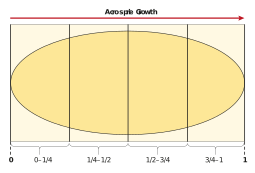
Figure: Scale of acrospire growth in a barley kernel
If the majority of the acrospires are in the 0-1/4 range, they are either dead or growing slowly. Kernels whose acrospires are longer than the kernel (> 1) are considered over modified. We need all acrospires to be the same length as this helps ensure the finished malt is uniform across the batch.
The implications of the indices of modification
The degree of modification of the malt we use as brewers has wide ranging effects on the brewing process and finished beer. Measuring and understanding the indices of modification is therefore essential. We specify the modification levels of the malt we purchase so that it matches the milling, mashing and wort separation technology in our breweries.
If the malt we receive is less modified than our specification, we can get problems with extract recovery due to being unable to mill it effectively and the starch being locked in the protein matrix. Insufficiently or unevenly modified malt also contains higher levels of undegraded β-glucans and arabinoxylans (pentosans) which can cause wort separation problems due to increased viscosity and also block beer filters later in the brewing process. Inadequately modified malt is also likely to have excessive levels of undegraded protein which can lead to problems in filtration and insufficient FAN for yeast nutrition.
If malt is over modified it can mill too easily leading to higher losses from dust extraction and wort separation problems due to a reduction in grist particle size. In some cases over modification can lead to the grain disintegrating and the mill rollers getting blocked and needing to be cleared by opening the mill. Excessively degraded malt proteins can lead to beer with inadequate body and poor foam stability. Over modified malt can also provide higher concentrations of amino acids in the wort, leading to excessive colour formation in the boil due to the Maillard reaction.