
Lesson 6 - Malt Quality
This lesson deals with malt quality. We explore each parameter on a malt specification sheet and identify why they are specified. We then examine how they affect beer and the brewing process.
Modification Analyses
The modification parameters shown below provide an index of malt modification. Because modification is a complex process no single analysis can provide the whole picture. Remember, we are looking for both the extent and evenness of modification.
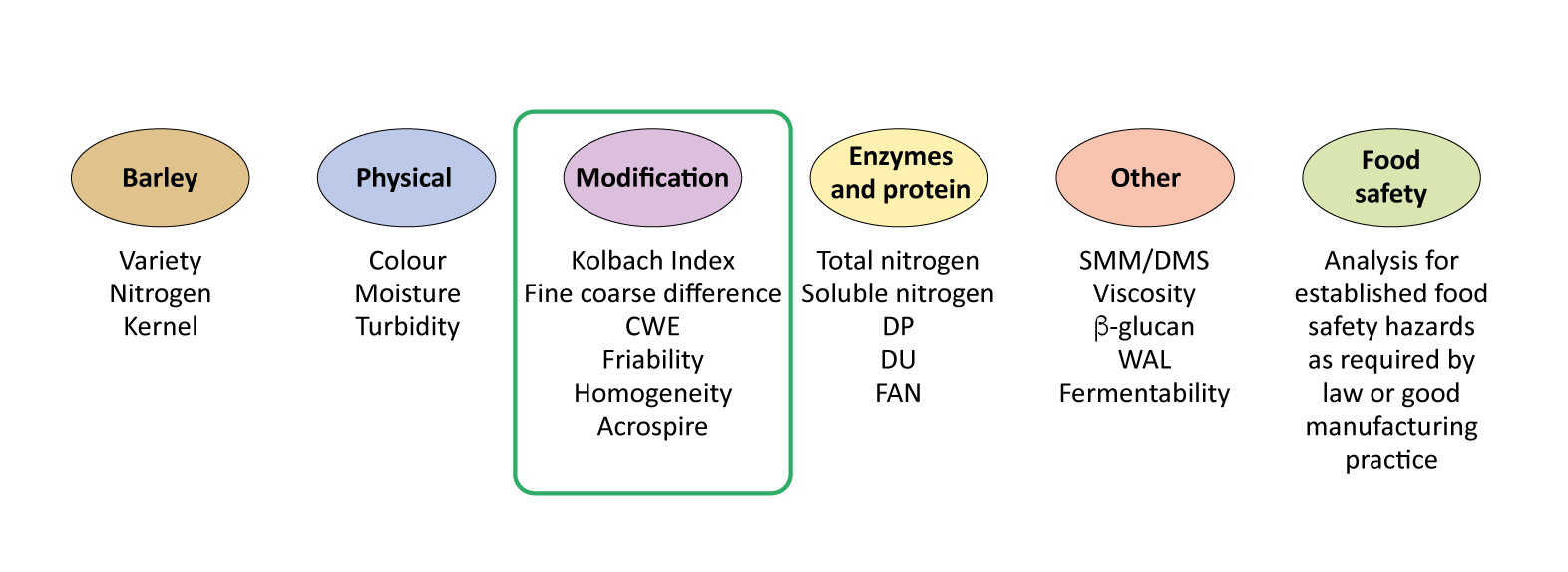
Modification can be determined in several ways.
Calcolfuor method
In the EBC calcofluor method, three sets of 40 kernels are embedded in a clay fixation block which holds them in place. They are then sanded longitudinally until half of the corn has been removed. The kernels are then stained with calcofluor and placed under UV light in an image analyser. The calcofluor binds to high molecular weight β-glucan in the cell walls and fluoresces under UV light, as seen in the image below. Kernels with areas that fluoresce indicate intact cell walls, hence incomplete modification. The total area of the fluorescence of 120 grains divided by the total endosperm area multiplied by 100 and subtracted from 100 is the modification percentage of a sample.
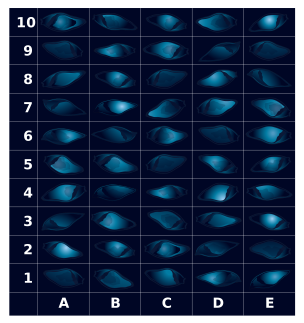
Figure: Calcofluor stained barley
Further reading:
This link provides more information an earlier version of this method:
https://link.springer.com/content/pdf/10.1007/BF02906200.pdf
Indirect determination:
Soluble Nitrogen Ratio (SNR) and Kolbach Index (KI)
The Soluble Nitrogen Ratio (SNR) and Kolbach Index (KI) tell us the extent of protein modification in the malt. They are determined by measuring total nitrogen (TN) and total soluble nitrogen (TSN) and undertaking this calculation:

The difference between KI and SNR is that for SNR we use wort from the IoB mash to determine soluble nitrogen and for KI we use the EBC (Congress mash).
The KI and SNR tell us how well the protein matrix has been broken down. A low value indicates partial protein modification while a high value indicates extensive modification.
The KI and SNR give us a very good indication of modification. Different malts have different specifications, but generally a KI or SNR of below 38 suggests that the malt is under modified. A KI or SNR greater than 45 KI indicates that the malt is over modified.