
Lesson 2 - Water
In this lesson we take a closer look at water from a utilities perspective. We will consider different forms of water treatment and look at the equipment required and operation thereof. The focus will be on treatment required for process and service water. Water chemistry will not be covered in any detail, as this is covered in Diploma Brewing Module 1.
Water Disinfection
Water disinfection plays a critical role in any brewery.
It falls into two main categories: that which provides a residual protection such as chlorine and chlorine dioxide, and that which only provides point sterilisation such as ultraviolet (UV) sterilisation. Let us look at each of these in more detail.
Chlorine
Chlorine is still widely used for municipal water treatment as it is easy to dose and provides residual protection.
From a brewing perspective, no chlorine can be tolerated in the product as it creates undesirable compounds. Hence the brewing water treatment process is more focused on removing chlorine than adding it.
Chlorine dioxide
Chlorine dioxide is in many ways more effective than chlorine at disinfecting water, since it works over a wider pH range. It also has the ability to attack biofilms inside pipes. It does not form undesirable chlorinated by-products that may cause unwanted flavours in the product. It is normally generated onsite, and in-situ (since the gas can be explosive!) using a chlorine dioxide generator which has either two or three components to generate the required chlorine dioxide. It can also be used to sterilise equipment when used as a final rinse water. The figure below shows a typical two-component generator.
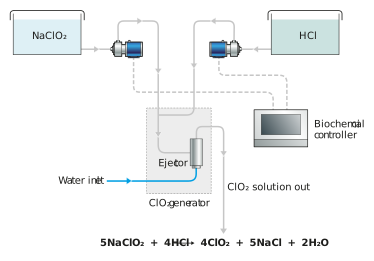
Figure: Typical chlorine dioxide generator
This chlorine dioxide generator uses two reagents – sodium chlorite (NaClO2) and hydrogen chloride (HCl). These reagents are mixed in a generator using precise dosing ratios to ensure that a high yield (typically 95% or higher) of chlorine dioxide gas is produced. This is then injected into water at a set ratio to have a precise concentration in the water. An intermediate higher concentration solution of 500–1000 mg/L can be made, and this can be dosed into the water feeding different applications.
Chlorine dioxide is used in varying concentrations for different applications:
-
Supply water disinfection is done at 0.2-0.5 mg/L.
-
Rinse water concentrations are at 1-2 mg/L.
-
Final rinse concentrations in CIP systems are at 2-5 mg/L.
An important consideration is the residual amount of chlorine dioxide left in the water. If the feed water is highly contaminated, more chlorine dioxide must be dosed to ensure there is residual chlorine dioxide left to provide effective sterilisation as the water moves through the system.
UV sterilisation
UV sterilisation only provides sterilisation at the point that it is used. Thus, it is normally reserved for sterilisation very close to the point of use and preferably in line. UV can also be used in conjunction with RO systems, as the water exiting these can only be contaminated by growth in the pipework.
Let us quickly look at how UV sterilisation works.
Lamps emitting light at a certain wavelength are enclosed in a housing, and water is fed through the housing. The figure below shows a typical UV steriliser.
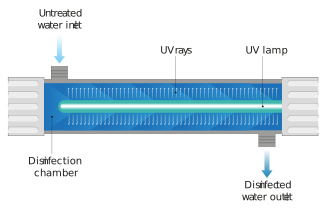
Figure: UV steriliser
Ultraviolet light has a wavelength at which photons of light are adsorbed by cells’ DNA. This prevents cells from replicating, and thus effectively kills off the organisms present in the water.
How well the steriliser works depends on the water quality, the water flowrate, the type of lamp, and the type of pathogens you need to destroy. UV sterilisers do not work well if the water is turbid, as particles can shield the organisms you want to destroy. The advantage of UV sterilisation is that it is a purely physical method and is chemical free. UV lamps have a finite lifespan, and provision has to be made for replacement and potentially standby configurations if continuous operation is required.