
Lesson 2 - Water
In this lesson we take a closer look at water from a utilities perspective. We will consider different forms of water treatment and look at the equipment required and operation thereof. The focus will be on treatment required for process and service water. Water chemistry will not be covered in any detail, as this is covered in Diploma Brewing Module 1.
Membrane Technology
Membranes are increasingly used in all aspects of water treatment. They cover a vast range.
The figure below shows the application of different types of membranes compared to particle filtration.
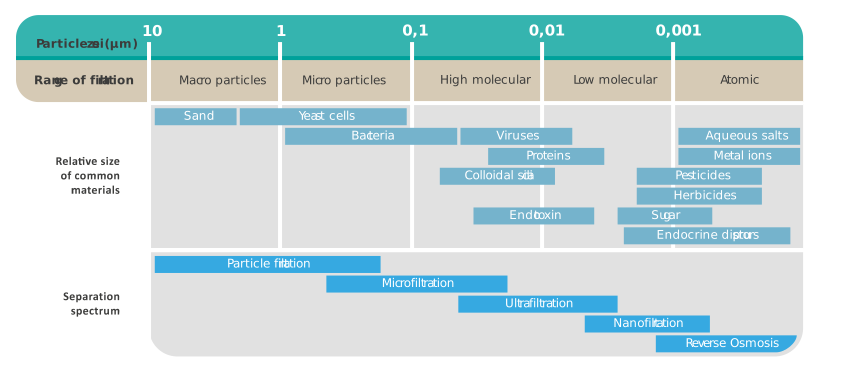
Figure: Ranges for various filtration technologies
As the size of the pores decreases, more particles can be taken out but the pressure required to operate the membranes increases.
For brewery water treatment, mainly ultrafiltration and reverse osmosis are used.
Let us look at a typical membrane filter. Most membrane filters consist of a double-sided sheet, which is essentially two membranes held together. These are tightly wound in a spiral. Raw water enters one end and filtered water exits the other end. The figure below shows an example of this.
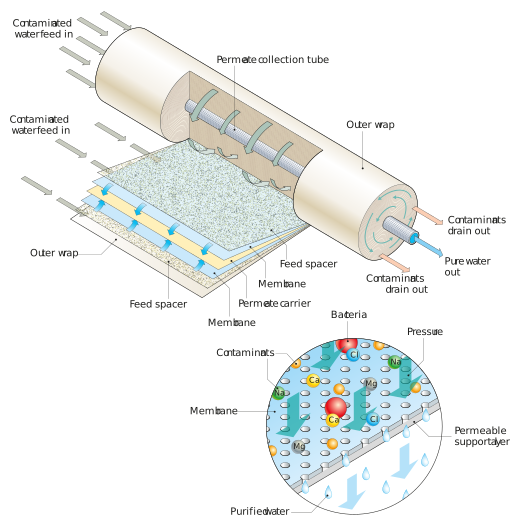 Figure: Typical membrane filter
Before we continue let us look at two flow patterns: dead-end and cross flow.
Dead-end versus crossflow filtration
There are two modes of operation for membrane filters: dead-end filtration and crossflow filtration.
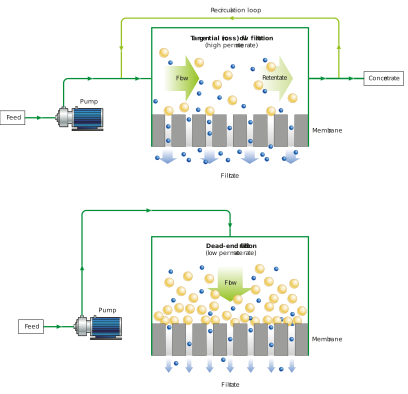
Figure: Crossflow and dead-end filtration
In dead-end operation, the particles accumulate in the filter, whilst with crossflow filtration they are constantly removed. Thus, with crossflow filtration the process can run for longer as the particles remain in the concentrate and do not foul the membrane as easily. However, this has limitations, as you have a concentrate stream to deal with and very high energy requirement for the recirculation loop pumping. With dead-end flow the membranes fill up, which results in an increase in pressure and the need to backflush.
Let us now look at two membrane technology options in more detail: ultrafiltration and reverse osmosis.
Ultrafiltration
Ultrafiltration is used extensively in brewing water treatment because:
-
It provides the perfect level of filtration, whilst delivering a very high yield.
-
It takes out particulates. From a microbiological point of view, it eliminates yeast and bacteria and even some viruses. From a mineral composition perspective, it does not alter the water composition, so if your water source is not overly hard you are not taking things out that you may need to add back in.
-
It does not need excessive pressure to operate and can be backflushed.
-
Many systems now also allow for hot sterilisation.
Reverse osmosis (RO)
Let us quickly define reverse osmosis in case you do not recall this definition from earlier studies.
Firstly, osmosis is the result of a concentration gradient across a semipermeable membrane. The water molecules on the less-concentrated side will attempt to balance the concentrations on both sides because of an osmotic pressure. In reverse osmosis, pressure is applied on the side with the concentrated solution to force the water molecules across the membrane to the clean water side.
Reverse osmosis has traditionally had one big drawback in that it is only maximum 80% efficient unless water recycling and secondary processing are used. This efficiency is a measure of how much water is recovered. The benefit of reverse osmosis is that it gives you pure water. It removes virtually all dissolved ions and effectively demineralises water.
RO membranes can clog or scale, and require cleaning in place (CIP) to clean them. For hard water, scaling can be a significant problem which requires lots of CIP. Scale inhibitors can also be used to help combat this. The figure below shows a typical double pass system which recycles the first concentrate and puts it through a second RO system.
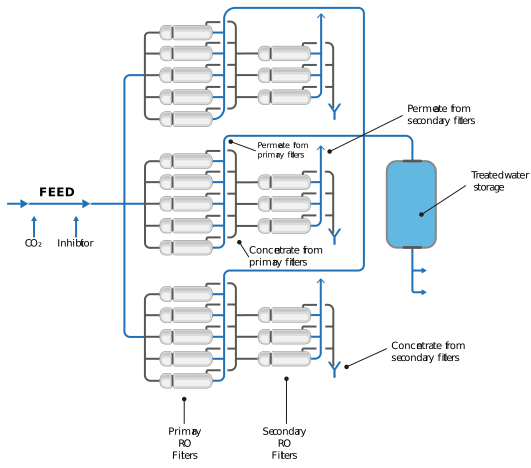
Figure: Typical RO water system with double pass
Newer types of membranes and housing can also allow for hot sterilisation to be carried out.
There have also been recent advances in the recycling of the concentrate stream. One such technology involves using lime precipitation along with membranes to treat the concentrate stream.