
Lesson 2 - Water
In this lesson we take a closer look at water from a utilities perspective. We will consider different forms of water treatment and look at the equipment required and operation thereof. The focus will be on treatment required for process and service water. Water chemistry will not be covered in any detail, as this is covered in Diploma Brewing Module 1.
Preface
Water is used at every stage of the brewing process and is the main ingredient in the product. It is also used for cleaning and utilities. As we all know, water is a scarce resource and is one that should be managed carefully.
In the non-brewing world, the key differentiation when it comes to water is ‘potable’ versus ‘non-potable’. Potable essentially means fit for human consumption. It is water that is safe to drink and is used in food preparation.
However, in brewing and related processes we tend to differentiate between product water which goes into the product, and filtered, process, and service water which do not.
But when it comes to water treatment, the differentiation is not that easy. In a perfect world, you would treat every bit of water only as much as required, but this would result in you having lots of different types of water, each requiring separate storage and distribution.
Brewery water types
(The actual names of the water categories can vary. However, most breweries use the terms below.)
1. Product water – interacts with the product, for example:
- Brewing and sparging water
- Dilution water for high gravity brewing
Brewing water can have many different requirements, and for the purposes of this lesson we will not focus on the complex water chemistry, as this is covered in detail in Diploma Brewing Module 1. Instead, we will focus more on the equipment and operations involved in water treatment.
2. Process water – helps various production processes to function, such as:
- Plant cleaning
- Plant and product cooling
3. Service water – supplies water to non-production (service) systems, notably cooling tower water and boiler feed water. Examples include:
- Raising steam in the boilers
- Cooling water in cooling towers
The service water used for steam raising will be further treated to ensure it does not damage the boiler and steam distribution system or affect its efficiency. This is covered later in this lesson and also in the Steam and Refrigeration Unit.
The treatment we apply to our water is hugely dependent on the quality of water we receive, and that depends on the source.
Sources of water
-
Spring water, harvested rainwater, clean river or lake water - only very simple water treatment is required if composition is consistent
-
Groundwater (boreholes) - Huge variability between different sites and potentially even seasonally
-
Rivers and dams - Variability depending on location, time of year, long-term weather, and pollution
-
Sea water
-
Water supplied by your local authority - Quality can be variable. Almost always considerably more expensive (pre-treatment, distribution costs, etc.), so use is minimised if other sources of appropriate quality can be used wholly or in part
Diploma in Brewing Module 1 covers the sources of water in much more detail.
Overview of water treatment
Water treatment is done via a series of steps. The further it goes down the process, the greater the quality of the water.
The first step is to get water onto your site with at least the largest particles such as fish and leaves removed. If the load of suspended solids is high, you may need to get this out fairly early in the process. Flocculation and sedimentation processes can be used for this.
You also do not want to spread microbiological contaminants throughout your process, so early disinfection may be required. This water may then be good enough to be used for floor cleaning or toilet flushing.
Further steps can then include the removal of finer particles, and taking out minerals and metals such as iron and manganese which are commonly found in certain groundwaters. These can form deposits in the process and can stain the equipment. Aeration and particulate filtration (mostly in the form of sand filters) are the simplest ways to get rid of these minerals, which can occur in high concentrations.
Water used for brewing may require further changes to mineral composition, and this involves several processes and options. Water used for dilution will have to be deaerated to prevent oxygen getting into our products.
Water used for heating and cooling purposes also has a unique set of requirements to prevent scaling or damage to equipment.
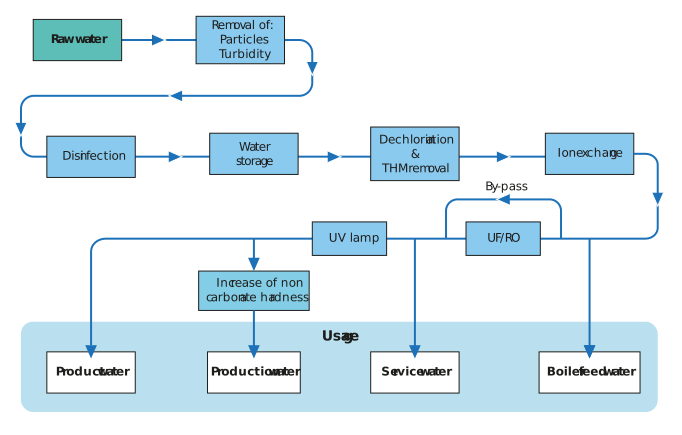
Figure: Typical brewery water scheme
Now let us go through the steps in more detail.