
Lesson 2 - Water
In this lesson we take a closer look at water from a utilities perspective. We will consider different forms of water treatment and look at the equipment required and operation thereof. The focus will be on treatment required for process and service water. Water chemistry will not be covered in any detail, as this is covered in Diploma Brewing Module 1.
Changing Water Composition
Whilst the focus here is not on producing brewing water, we need to briefly look at a few more traditional methods for water treatment used to ensure that both the process water and product water composition meet the requirements.
We will not delve too deeply into the water chemistry. The following is a brief explanation of a few terms.
All water contains cations (positively charged ions) and anions (negatively charged ions), which together make up the total dissolved solids in the water.
The first term we need to understand is ‘water hardness’. This is an indication of the amount of certain minerals dissolved in the water. Hardness consists of two parts: permanent hardness and temporary hardness.
Permanent hardness cannot be removed (precipitated out) by boiling. It consists of the non-carbonate salts such as sulphates, chlorides, and nitrates of calcium or magnesium. The removal of permanent hardness is achieved using an ion exchange column.
Temporary hardness can be removed by boiling as the carbonate or bicarbonate salts of calcium or magnesium precipitate out. Another method is to add calcium hydroxide (Ca(OH)2), which precipitates calcium and magnesium carbonates.
If the water hardness is too high, there can be undesirable effects both in the product and in scaling of equipment, thus it needs to be adjusted.
The next important term is alkalinity. Alkalinity is determined by the carbonate content of the water. High alkalinity increases the pH of the water. Chloride, sulphate, and nitrate are referred to as the Equivalent Mineral Acidity (EMA), also called Salts of Strong Acids (SSA), and they make up the balance of the anions. The figure below shows this in a form that is easier to understand.
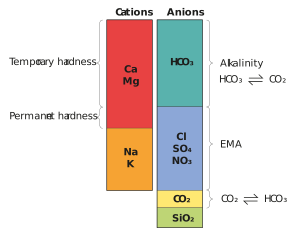
Figure: Water cations and anions in relation to hardness and alkalinity
Mineral composition refers to the content and relative ratios of minerals in the water.
There are a number of methods that can be used to alter water composition. They can be divided into those that take components out of the water and those that add components to the water. Adding components to water is required to meet certain brewing water requirements; this is beyond the scope of utilities, so we will not go into detail on this.
Taking components out of water has traditionally involved two methods: lime precipitation to remove carbonates, and ion exchange mainly to soften water (remove some hardness). Both are still used in certain plants, with ion exchange commonly used. Let us look at lime precipitation first.
Lime precipitation
Lime, calcium hydroxide Ca(OH)2, is added to the water to precipitate out carbonate hardness.
There are two main methods associated with lime precipitation:
-
With one-stage or open lime precipitation, calcium bicarbonate is targeted, and this precipitates out as calcium carbonate (CaCO3). This method also targets iron and manganese.
-
If the magnesium content is high, a pressurised two-stage system is required. In this case, iron and manganese are not removed.
Lime precipitation requires fairly large reactors, and the precipitates can be difficult to separate and to dispose of. Traditionally, sand filters were used to aid in the separation. However, given advances in membrane filtration, which can be used to remove the precipitates, lime precipitation could once again become a viable option.
Lime precipitation was patented in 1841 by Dr Thomas Clarke, who used it to soften the Thames river water.
Next we will look at the commonly used method for softening water – ion exchange.