
Lesson 2 - Water
In this lesson we take a closer look at water from a utilities perspective. We will consider different forms of water treatment and look at the equipment required and operation thereof. The focus will be on treatment required for process and service water. Water chemistry will not be covered in any detail, as this is covered in Diploma Brewing Module 1.
Ion Exchange
Whilst lime precipitation permanently removes mineral components from the water, ion exchange does exactly what it says – it exchanges some ions for other ions.
Ion exchange uses polymer resin beads that have either an anion (negative ion) or cation (positive ion) exchange site.
As water flows through the resin beads, ions are exchanged using either a cation or anion exchange.
There are four basic types of ion exchange resin in water treatment:
-
Weakly acidic cation exchanger
-
Strongly acidic cation exchanger
-
Weakly basic anion exchanger
-
Strongly basic anion exchanger
Let us look at the basic structure of an ion exchanger. The figure below shows the main components.
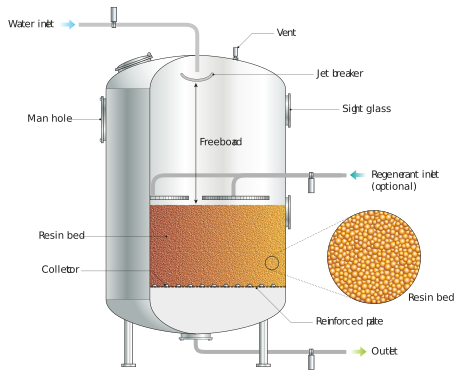
Figure: Typical resin ion exchange column
Water enters the top of the column and is spread to flow across the bed. The resin bed is held on top of a perforated plate. As the inlet water flows through the bed, ions are exchanged. Water exits the column at the bottom. Regenerant can be pumped through the bed either from the bottom (counter flow regeneration) or from above the bed (co-flow regeneration).
Let us now look at each type of ion exchange in more detail.
Weak Acid Cation (WAC): Common water softeners
WAC exchangers only remove calcium (Ca2+) and magnesium (Mg2+) ions bound to bicarbonate (HCO3-) or temporary hardness. This happens under alkaline conditions and is known as de-alkalisation.
First, hydrogen (H+) ions are bound to the resin which contains carboxylic acid groups. As bicarbonate-rich water passes through it, the resin exchanges its hydrogen ions for calcium and magnesium ions. The released hydrogen ion then reacts with the bicarbonate and forms water and carbon dioxide which can be removed in a degassing tower.
The figure below shows a typical degassing tower operation.
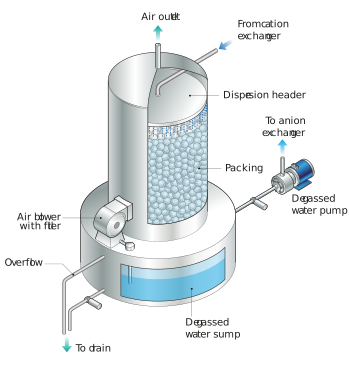
Figure: Degasser operation
Degassers help to reduce the load on the anion exchangers by forcing CO2 out. This reduces the alkalinity by effectively reducing the bicarbonate loading. WAC exchangers have a higher capacity than SAC exchangers, and are easily regenerated using strong acids such as hydrochloric or sulphuric acid.
Strong Acid Cation (SAC)
The SAC exchange is similar to the WAC, except that it creates much softer water. The WAC only removes calcium and magnesium that is bound to bicarbonates, but the SAC exchange removes all divalent (metal2+) metal cations. They are exchanged with sodium (Na+) ions or hydrogen (H+) ions.
The SAC with H+ ions also forms acidic compounds, and thus the water pH will drop significantly. Either a brine solution or a strong acid is used for the regenerations.
Weak Base Anion (WBA)
A WBA exchanger is an anion remover. In particular, the anions of strong acids such as chlorides (Cl-), sulphates (SO42-), and nitrates (NO3-) are exchanged with hydroxide. However, silicates are not removed.
Like a WAC, this system generates carbon dioxide, and must be vented. Sodium hydroxide is used for the regeneration.
Strong Base Anion (SBA)
The SBA exchanger removes both strong and weak acid anions, including carbonates and silicates. The system uses hydroxide as the exchange ion, but can also use chloride. Regeneration is normally done with NaOH.
The key points of the four main ion exchange systems are summarised in the table below.
Table: Summary of ion exchange types
|
|
WAC |
SAC |
WBA |
SBA |
|
Removes |
Ca²+ and Mg²+ associated with bicarbonate ions in alkaline conditions |
All divalent metal ions at any pH |
Anions of strong acids (e.g. Cl-, SO42-, and NO3-) |
Strong and weak acid anions (same as WBA but also H2CO3 and silicates) |
|
Exchange Ion |
H+ |
Na+, K+, or H+ |
OH- |
OH- (or Cl-, but can be limiting) |
|
Produces CO2 |
Yes |
No |
Yes |
No |
|
Regeneration Chemicals |
Strong acids (HCI or H2SO4) |
NaCl or KCI |
NaOH |
NaOH |
In addition to the stand-alone ion exchangers, it is possible to combine them in systems – either in a serial system or as a mixed bed reactor. Let us have a look at this next.