
Lesson 2 - Water
In this lesson we take a closer look at water from a utilities perspective. We will consider different forms of water treatment and look at the equipment required and operation thereof. The focus will be on treatment required for process and service water. Water chemistry will not be covered in any detail, as this is covered in Diploma Brewing Module 1.
Raw Water Treatment - Activated Carbon Filters
Activated carbon filters are widely used to remove chlorine, trihalomethanes (THMs), odours and off-flavours, and certain organic compounds.
Activated carbon is carbon that has been activated to make it more adsorptive to these compounds. This is done by processing the carbon to create a multitude of shallow pores that substantially increase the surface area available for reactions. Activated carbon comes in powder, granular, or pellet form, but in brewing granular activated carbon is most commonly used. The carbon also comes from different sources such as coconut and coal; it is important to check that the correct type and grade of carbon for your application is selected. In brewing, the carbon is normally from a coconut shell source and not from coal. Activation for this application is normally done with steam.
Within an activated carbon filter, free chlorine is quickly converted to chloride within the first few centimetres of the bed and the activated carbon acts as a catalyst for the reaction. Other compounds such as THMs are adsorbed as the water progresses through the bed. When the bed becomes saturated, the activated carbon must be regenerated or replaced. Care should also be taken if the water is static for significant periods of time, as desorption can occur.
The figure below shows the typical operation of a carbon filter. During normal operation, chlorine, THMs, and other substances are removed. The filter is then periodically backwashed, and steam is used to strip out the volatiles and sterilise the filter.
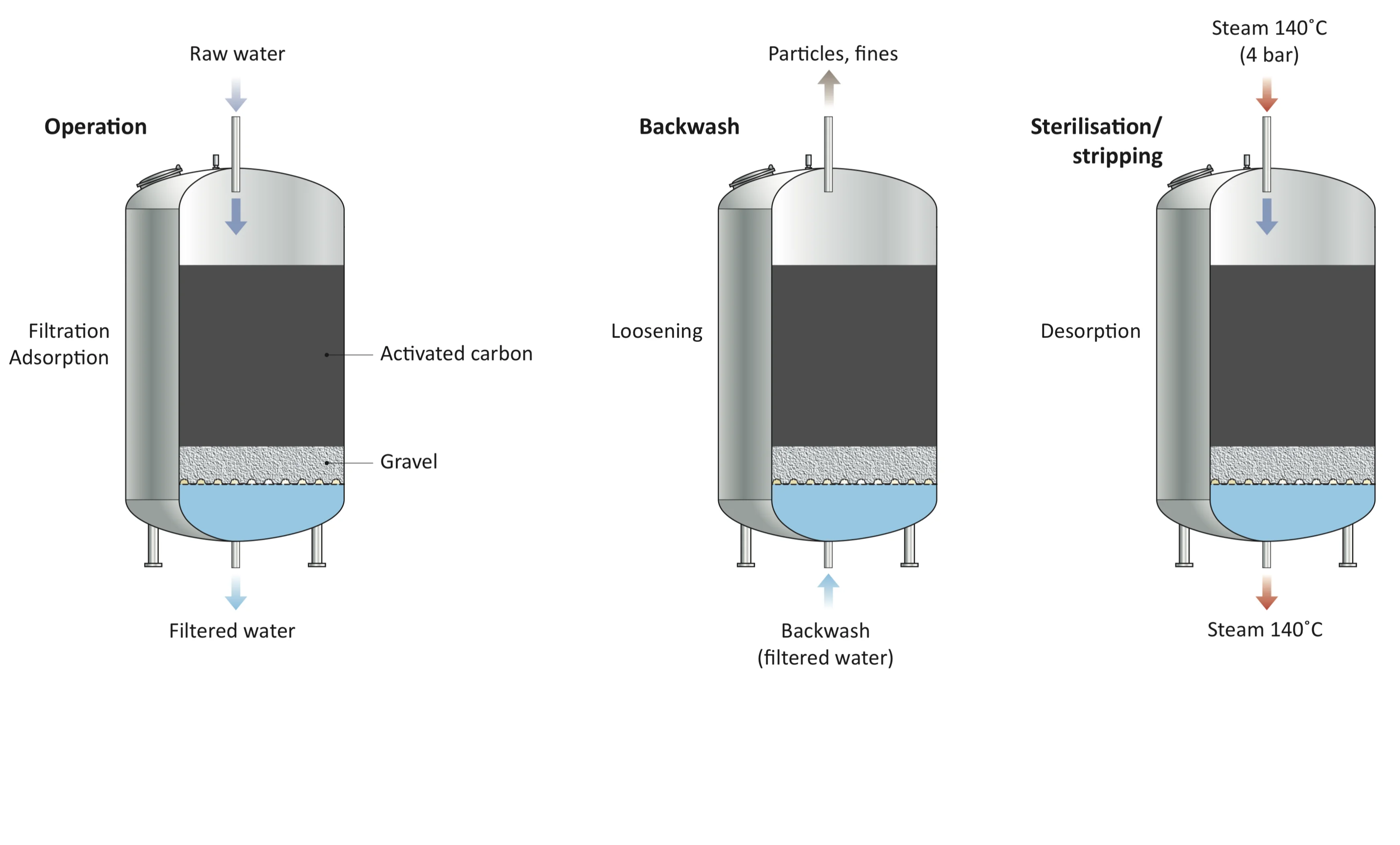
Figure: Operation of activated carbon filters
However, the effectiveness of steam has been questioned for two reasons. Firstly, it may not reach the entire bed due to short-circuiting. Secondly, it takes a long time for the filter to cool down. A better practice is to do a hot water sterilisation at 95°C to ensure the bed is completely sterilised. Such a system is shown in the figure below.
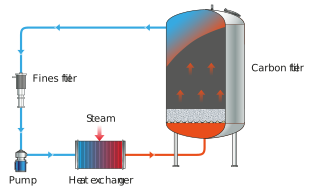
Figure: Hot water sanitation of an activated carbon filter
The hot water mixes the bed, and thus is much better at getting to every last bit of the activated carbon. This potentially also saves energy, as typically less steam is used in the process.
The following webinar is a good resource on carbon filtration. Note: this is for illustrative purposes only and is not a recommendation or endorsement of the supplier’s product.