
Lesson 2 - Water
In this lesson we take a closer look at water from a utilities perspective. We will consider different forms of water treatment and look at the equipment required and operation thereof. The focus will be on treatment required for process and service water. Water chemistry will not be covered in any detail, as this is covered in Diploma Brewing Module 1.
Raw Water Treatment – Sand and Multimedia Filters
Raw water can go through a variety of treatment steps, and there are different options available. We will cover some of these in this section, including sand filters, multimedia filters, and activated carbon filters. Although membranes were traditionally seen as only appropriate for use in final water treatment, recent improvements have allowed them to be used far more widely.
Sand filters and multimedia filters
Sand filters and multimedia filters operate on the same principle.
The figure below shows a typical multimedia filter. Note its distinct layers.
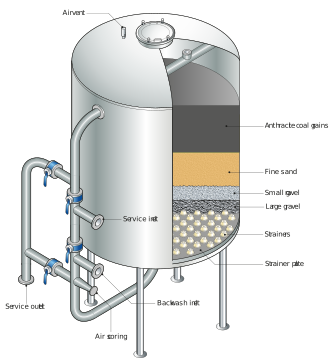
Figure: Typical pressurised multimedia filter
Note that water enters from the top and exits at the bottom and particulate matter is caught in the filter media. The filters are backwashed from the bottom. The bed is aerated either simultaneously with the water backwash or before the backwash to loosen it. At the end of the backwash, all the trapped particles are removed and the filter materials reform in the layers, with the heavier filter materials settling at the bottom and the lighter ones at the top.
The backwash process uses a lot of water. This water used to be sent to drain, but most modern systems incorporate a recovery system so that most of it can be reused. All the backwash water is recovered into a backwash holding tank where solids sediment out. The backwash water is then cleaned using particle filters before it is fed back through the sand filters along with the untreated raw water.
The continuous sand filter allows for the sand filter to be continuously fed with raw water whilst the sand is internally cleaned, and pollutants removed during the operation. This can also be used with in-line coagulation and flocculation so that it provides for a more efficient method of particle removal. The following figure shows the basic components.
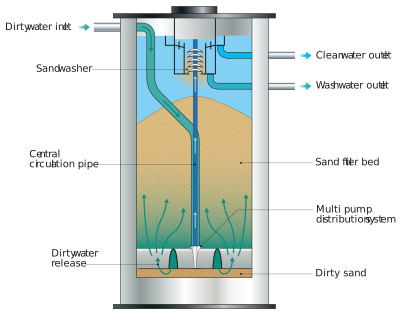
Figure: Continuously flushed sand filter
Raw water is continuously fed from the bottom. The dirtiest sand is at the bottom, and this is continuously fed up through an internal pipe to a sand washer where the sand is cleaned and put back on the top of the bed. A small amount of wastewater exits with the particles. Clean water exits from the top of the filter.
For a video on the continuous sand filter, see the link below. Note: this is for illustrative purposes only and is not a recommendation or endorsement of the supplier’s product.