
Lesson 2 - Water
In this lesson we take a closer look at water from a utilities perspective. We will consider different forms of water treatment and look at the equipment required and operation thereof. The focus will be on treatment required for process and service water. Water chemistry will not be covered in any detail, as this is covered in Diploma Brewing Module 1.
Water Intake and Pre-treatment
Depending on the source of water, different forms of pre-treatment are required. These include sedimentation, aeration, pH adjustment, and disinfection. However, first we need to get the water into the brewery.
Water intake
Many breweries’ water comes pumped to them from a reliable and good quality source. Others are responsible for some or all of the steps to get raw water onto site and into a form ready for further treatment.
Water intake is done by the collection, harvesting, or pumping of the water. This is normally via pumps and pipelines into a storage receptacle, although it can be directly into the water treatment plant.
Sizing of the pumping and storage facilities (reservoirs, tanks, etc) depends on a variety of factors, including the reliability of the water supply and of the pumping system.
The main aim of pre-treatment is to get rid of the bulk of particulate matter and to ensure that water is adequately disinfected to prevent harmful pathogens entering the brewery.
Some raw water needs rough screening to remove everything from plant matter to plastic to fish.
Sedimentation
The next step is to settle out the bulk of the particles in the water. This can be done through sedimentation. Sedimentation is the settling out of particles. Some particles can settle out individually. Often particles are in what is called a colloidal suspension because the particles all carry a charge. By adding coagulants, the charge on the particles is neutralised and the particles are free to coagulate. By adding flocculants, these particles form flocs that can settle out. It is a bit like getting people at a party to talk to each other (coagulate) and then form groups that clump together (flocculate) before leaving the party (sedimentation). Without coagulation, nothing will happen. The figure below shows the steps involved in this process.
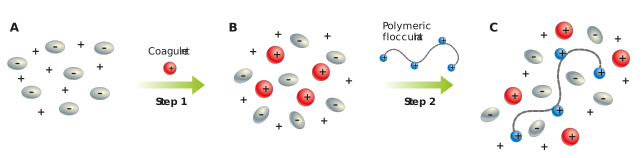
Figure: Coagulation and flocculation
So, the first step in sedimentation is always coagulation; this is always followed by flocculation.
Aeration
Aeration can happen at various stages in water treatment. It has a two-fold function. Firstly, it oxidises certain metal ions such as iron and manganese and turns them into oxides that can precipitate out. Secondly, it strips out volatiles such as hydrogen sulphide (H2S) and volatile organic compounds (VOCs). It can also decrease dissolved CO2 and thus raise the pH of the water. This is because dissolved CO2 forms weak acids in the water.
The removal of iron and manganese is of particular importance when using groundwater. Whilst aeration is very effective when dealing with iron, manganese requires more vigorous treatment. This is often done using “manganese greensand” which is a specially formulated material which is capable of reducing iron and manganese into insoluble forms which precipitate out. The greensand is backwashed and regenerated using a weak potassium permanganate or sodium hypochlorite solution.
There are numerous aeration options. Some are simple inline systems. However, if volatile stripping is required then it is best to do the aeration in a system open to the atmosphere. An example of this is shown in the figure below.
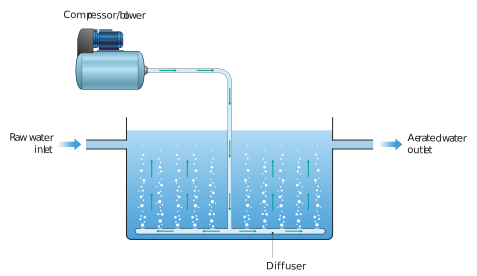
Figure: Water aeration system
Packed towers can also be used for stripping, but these are susceptible to fouling and so cleaning requirements must be considered.
pH adjustment
Depending on the quality of the incoming water, the pH may have to be adjusted to ensure the rest of the treatment process performs optimally. A simple dosing system for chemicals can effectively do this at any point in the process.
Disinfection
The more microbiologically contaminated the water source, the higher the risk of organisms being carried through the water supply and becoming a ‘growing’ problem. Thus, the earlier they can be dealt with the better. The best option may be to disinfect all water before it enters your water treatment plant. At this early stage, chlorine or chlorine dioxide are the most suitable options. We will discuss them later in this lesson.