
Lesson 4 - Steam Technology
This lesson takes a closer look at steam technology. It explores the generation of steam in boilers, as well as the distribution system and its components. It also considers the legal requirements associated with steam technology.
Condensate Recovery
Condensate return is crucial to the efficient operation of the boiler.
Condensate is hot and has already been treated both as feedwater and also while in the boiler. Therefore, getting the maximum condensate return saves energy, water, and treatment costs. Condensate has to be recovered from the lines as well as from points of use. Steam traps are essential to ensure we get the condensate back and leave the steam behind.
Steam traps
Steam traps are designed to ensure that the heat energy of the steam is fully utilised through condensation before the condensate is returned.
There are two types of steam trap applications:
-
Process steam traps, which are fitted to process equipment.
-
Drainage steam traps, which are fitted to steam lines.
There are also a number of steam trap designs. They can be divided into the following three categories:
-
Thermostatic traps, which are actuated by temperature.
-
Mechanical traps, which are actuated by liquid level.
-
Thermodynamic traps, which are actuated by a combination of thermodynamic and fluid dynamic properties.
One of the most basic types of thermostatic traps is a bimetallic trap. Metal discs expand with the heat of steam, and this seals the exit from the trap. Condensate cools the metallic strips, which opens the trap. The figure below shows the principle of operation.
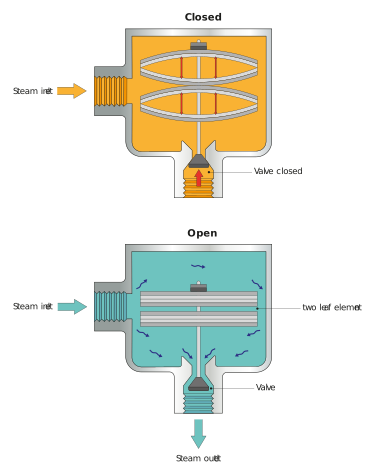
Figure: Bimetallic steam trap
One of the most common mechanical traps is a float trap. The figure below shows a typical float trap.
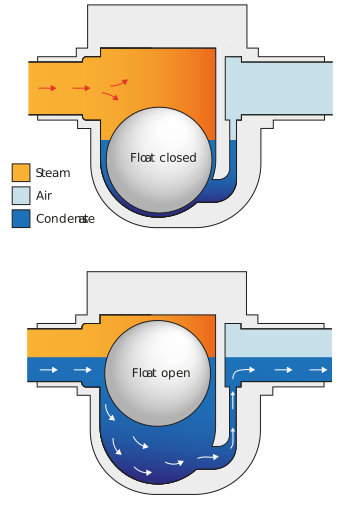
Figure: Float steam trap
As the condensate level increases, the float rises and opens the drain line. If there is no condensate, the drain line stays closed.
The main thing to consider is that thermostatic traps tend to drain in spurts, as there is always a lag with the temperature change. Mechanical traps drain continuously and there is thus less chance of condensate building up.
Condensate return
There are two options to consider for condensate return: a vented system or a pressurised system. With a vented system, the condensate is collected into a vented condensate tank. This means that the condensate will release flash steam as the condensate is above 100°C. A typical vented system is shown in the figure below.
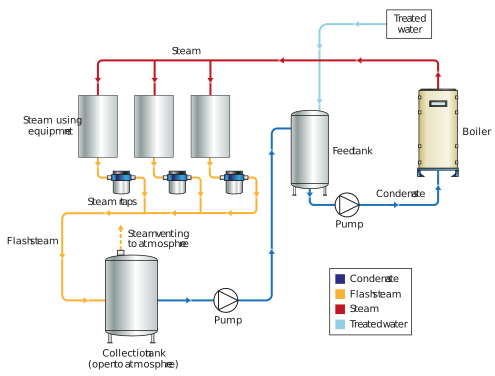
Figure: Vented condensate recovery system
It is also possible to keep the condensate pressurised and pump it back to the boiler house without flashing. The figure below shows a typical system.
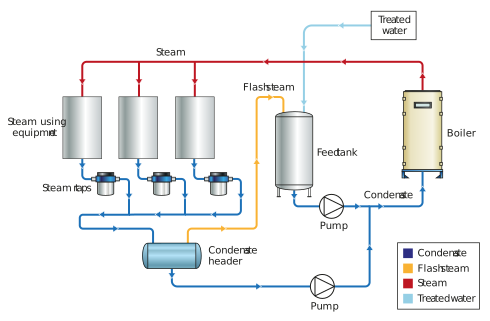
Figure: Pressurised condensate recovery system
This allows for flash steam to be recovered or used for other heating applications. Pressurised systems are more expensive, but they save water and energy.
Condensate should be monitored for contamination. As steam is often used to heat detergents, a leaking heat exchanger can easily contaminate the condensate. In larger plants, conductivity probes are often installed to detect any contamination.
Let’s look at an example of how to calculate condensate recovery:
A boiler generates 5 t per hour of saturated steam at 1 MPa. Boiler fresh water make up is 0.5 t per hour. From this we can determine that the amount of condensate being returned is 4.5 tonnes per hour. To calculate percentage condensate recovery we can use the equation as shown below:
