
Lesson 4 - Steam Technology
This lesson takes a closer look at steam technology. It explores the generation of steam in boilers, as well as the distribution system and its components. It also considers the legal requirements associated with steam technology.
Preface
Steam is used for most heating applications in a brewery.
Steam is a ‘hot topic’! Steam consumption accounts for most of the thermal energy used in a brewery. Steam is raised in a boiler using a number of energy sources, from coal and gas, to electricity and solar. The local availability of fuels will play a big role in the choice of boiler. Some breweries may even buy steam from an external supplier, but they will still require the steam and condensate networks to ensure the most efficient use of the steam.
Overall steam network
The steam network consists of generation, distribution, use, and recovery. The figure below gives an overview of a typical steam network.
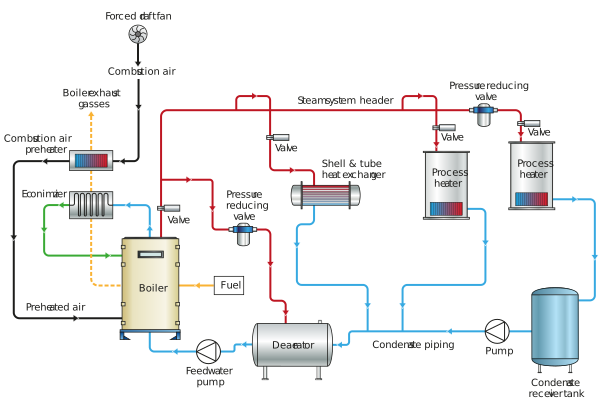
Figure: Steam network schematic
Boilers sit At the heart of steam generation. They rely on combustion to turn fuel into heat. This heat is then used to turn water into steam. Steam distribution consists of pipe networks that take the steam to the end users. The end users then extract the heating energy available in the steam, and in the process, the steam condenses back into water or condensate. This condensate has to be recovered so that it can go back to the boiler for the process to be repeated. Unfortunately, this is not a closed loop, and condensate goes missing. We thus need to have make-up water. Let’s look at each of these key steps in greater detail, starting with steam generation.