
Lesson 4 - Steam Technology
This lesson takes a closer look at steam technology. It explores the generation of steam in boilers, as well as the distribution system and its components. It also considers the legal requirements associated with steam technology.
Steam Distribution
The ability to distribute steam effectively is critical to ensure that user requirements are met.
Steam has to be supplied to users at the correct pressure and in the required quantities. Typically, steam pressures of 600 to 1,000 kPa are used to supply the brewery. Lower pressures require larger lines, but also incur smaller heat losses in the lines as the temperatures are lower. The pressure is then reduced to the specific pressure required by the various users.
The steam network can be quite extensive. These lines must be sized correctly and must also take into account friction losses and heat losses resulting in the cooling of the steam and the formation of condensate. Fluctuations in demand can be met by using accumulators.
Accumulators
Boilers cannot respond instantaneously to the demands of the brewery. If a boiler is large, it has some reserve in terms of its steam space. However, if a boiler is small, a steam accumulator can be used to provide more capacity for instantaneous demand.
A steam accumulator is essentially a way of extending the capacity of the boiler system to store energy. When a boiler generates excess steam, this is injected into the accumulator. The accumulator is essentially a store of water under pressure. When there is an excess demand for steam, the accumulator discharge opens. The fall in pressure results in the saturated liquid being above its saturation temperature, so a portion of the water will thus turn to steam. The figure below shows a typical arrangement for a steam accumulator.
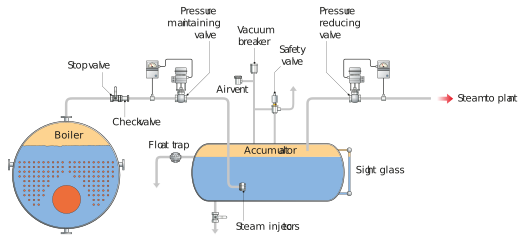
Figure: Steam accumulator
A steam accumulator is a misleading name, as we are not storing steam, but the energy to create steam.
Steam lines
We must consider a few basic points when installing steam lines. A general guideline is that steam velocities should be less than 25 m/s. Condensate forming in steam lines can cause many problems, including corrosion and water hammer damage. If slugs of condensate form, these get pushed forward at the speed of the steam, which at 25 m/s is 90 km/hr. Steam at this speed is acceptable as it is a light gas, but not a heavy liquid. If you are driving in a vehicle at 90 km/hr, you may be happy to stick your hand out of the window on a clear day, but the impact of rain drops on a rainy day can hurt a lot. Similarly, these slugs of condensate can cause a lot of damage to pipework and equipment. The following figure shows how these slugs form.
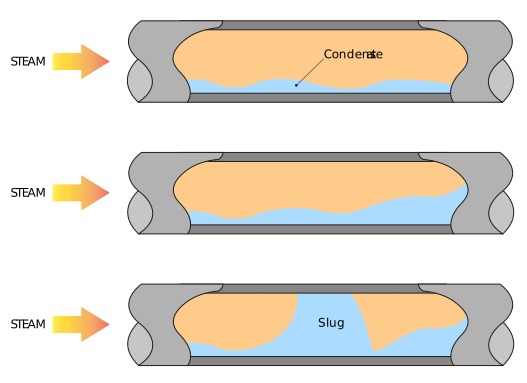
Figure: Formation of condensate slugs
In order to prevent this, the lines should slope slightly (a 1% slope is normally recommended if the fall is in the direction of flow; a 2.5% slope is recommended if the line rises in the direction of flow). Condensate drainage points are also required at intervals of 30-50 m, as well as at any low points. The figure below shows a typical drainage configuration.
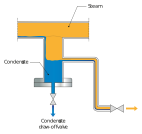
Figure: Condensate drainage point
It is important that the off-take point be sized so that the condensate cannot be carried across it. The drainage point at the bottom of the vertical pipe allows for blowdown and to clear any debris that may accumulate. This is called a ‘mud-leg’. The mud-leg also prevents the steam trap from getting blocked up by the debris.
Because of the temperature range, the lines can expand significantly. Allowances for expansion must thus be made. These are typically in the form of expansion loops or bellows at 25 m intervals, and the pipe supports must permit movement of the pipe. The figure below shows a typical expansion loop.
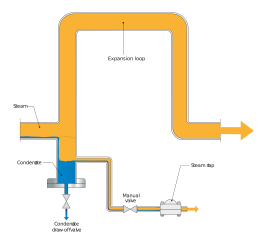
Figure: Steam expansion loop
Because the steam lines are normally sloping downwards, drainage is required at the point at which the expansion loop rises.
Steam off-take points should always be fitted on the top of the steam main. The figure below shows that condensate carryover is avoided by doing this.
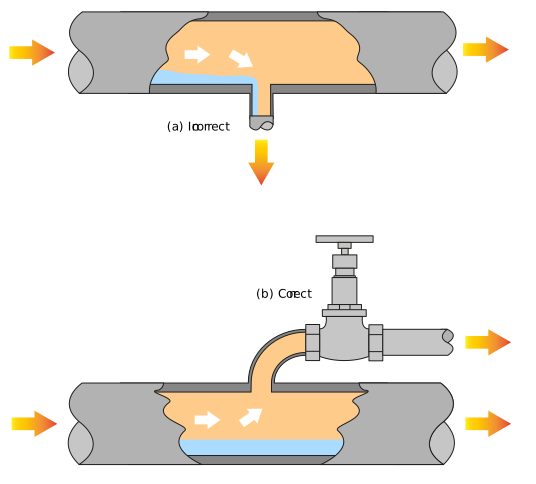
Figure: Steam off-take
Let’s take a closer look at the typical steam line fittings and equipment that we find in the brewery.