
Lesson 4 - Steam Technology
This lesson takes a closer look at steam technology. It explores the generation of steam in boilers, as well as the distribution system and its components. It also considers the legal requirements associated with steam technology.
Steam Generation: Boilers
Steam is predominately generated in boilers by heating water using the heat generated by the combustion of fuels. The water changes phase from liquid to steam under pressure and is then distributed.
There are principally three types of boilers: shell, water tube, and coil.
-
In shell boilers, the ‘fire’ is kept in tubes that are passed through a shell filled with water.
-
In water tube boilers, the water is kept in the tubes and the ‘fire’ is on the outside. Water tube boilers are able to produce high outputs and high pressures, but their efficiencies are typically lower than those of shell boilers.
-
Coil boilers generate steam by running water through a coil inside a shell.
When it comes to brewing applications, we tend to use shell boilers, so we will look closely at this design only.
Shell (fire-tube) boilers
Shell boilers have various designs, but the general principle remains the same. The following figure shows a typical shell (fire-tube) boiler.
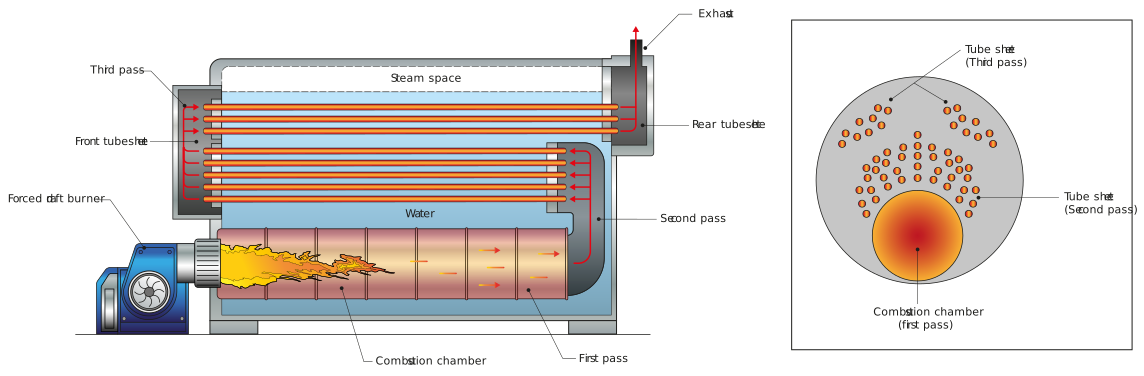
Figure: Shell (fire-tube) boiler
The figure above shows a wet-back design. This means that the furnace or combustion section is surrounded by water. The combustion tube (or tubes) can be around one metre in diameter, depending on the boiler size. Combustion is normally completed in this section, and roughly 50% of the heat is transferred to the water. The hot combustion gases then go through a number of steam passes consisting of tubes that are typically 50 mm in diameter. Another 30% of the heat is typically transferred here. This boiler is a three-pass boiler as the combustion section is seen as a pass.
The water level is carefully controlled to cover the tubes. The tubes will overheat if they are not covered by water. The steam space above the tubes allows for water droplets to separate out from the steam, and also provides a small steam buffer.
Now, let’s have a closer look at combustion.