
Lesson 4 - Steam Technology
This lesson takes a closer look at steam technology. It explores the generation of steam in boilers, as well as the distribution system and its components. It also considers the legal requirements associated with steam technology.
Steam Metering
Steam metering is important for process control and to manage steam usage.
The two most common steam meters used are the orifice plate flow meter and the vortex flow meter.
Orifice plate flow meter
The orifice plate flow meter is the most basic of all steam flow meters. It uses the drop in pressure over an orifice to provide the velocity. The figure below shows the installation of a typical orifice plate flow meter.
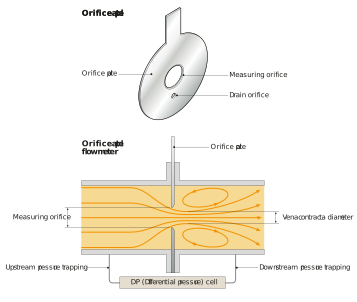
Figure: Orifice plate flow meter
In order to obtain greater accuracy, orifice plate flow meters should be equipped with temperature and pressure transmitters to compensate for fluctuations. Typically, for accuracy, the pressure tie-in point must be positioned 10 pipe diameters before and five pipe diameters after the orifice plate on a straight pipe run. Orifice plate flow meters are relatively cheap; however, they have a turndown ratio of 1:4, which means they are not accurate if operating at less than 25% of their designed flow rate.
Vortex flow meter
Vortex flow meters work on the principle that if there is a column-shaped obstruction in a flowing fluid, it will generate alternating vortices downstream. The frequency of the vortices is proportional to the velocity. The figure below illustrates how this works.
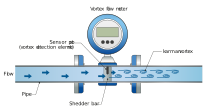
Figure: Vortex flow meter
This principle can be combined with pressure and temperature measurements to give an accurate mass flow, which is useful when measuring the mass of steam. They do require long runs of pipe before and after. The typical installation guides are shown below, which also applies to the orifice plate installation.
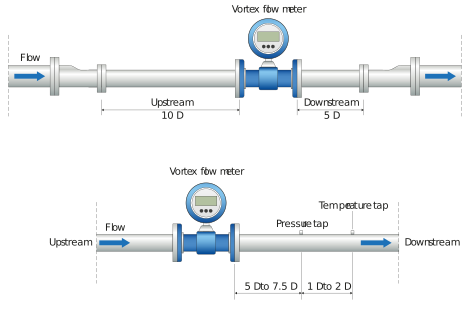
Figure: Installation of a vortex flow meter
Vortex flow meters are available in a large range of line sizes. They provide reasonable turndown ratios as long as they are not oversized.
So far, we have discovered how generation and distribution helps to supply end users with steam. We will discuss typical steam uses at the end of this lesson, but for now, let’s first take a quick look at how to get the condensate back.