
Lesson 4 - Steam Technology
This lesson takes a closer look at steam technology. It explores the generation of steam in boilers, as well as the distribution system and its components. It also considers the legal requirements associated with steam technology.
Steam Line Fittings and Equipment
All steam lines need to have fittings that ensure steam quality is maintained, and flow and pressure are controlled.
Considering the dangers of hot steam, it is essential that the steam line can be isolated. These valves are normally manual. A wide range of valve types can be used, but it is important to ensure that they are suitable for use with steam. Control valves should not be used as isolation valves.
Although we think of steam as being clean, in some instances carryover from the boilers may occur, which can cause debris to accumulate in the lines. As a result, steam strainers are used to remove any solids. It is considered good practice to install them before any valves, flowmeters, or other equipment in the process. The figure below shows a typical strainer.
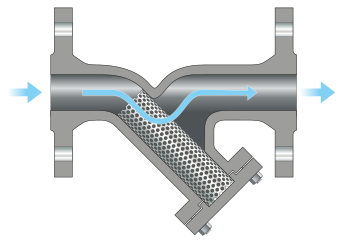
Figure: Steam strainer
Where steam is supplied to a user, it is reduced to the correct pressure. The following is a typical design for a pressure reducing station.
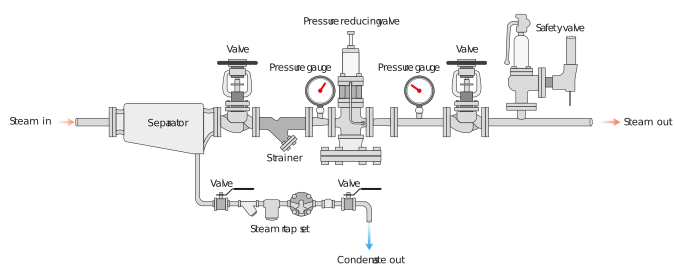
Figure: Pressure reducing valve station
Let’s have a closer look at some of its components.
Pressure reducing valves
Pressure reducing valves can be manual. If manual, they are self-actuating. If automated, they are controlled with reference to a pressure measurement.
For smaller applications, or those with fairly constant loads, direct-acting valves can be used. These work with bellows or springs that can be adjusted. For greater accuracy, a connection from the downstream line to a diaphragm provides ‘feedback’ as more downstream pressure will aid in closing the valve even more. An example of these are shown in the figure below.
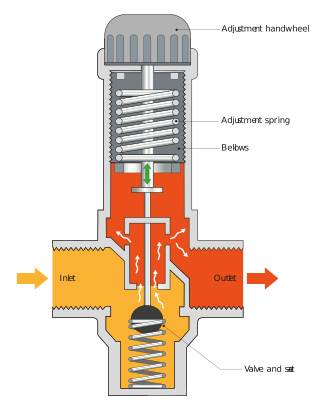
Figure: Direct-acting pressure reducing valve
Another option that can be used is a pilot-operated valve. Here, the downstream pressure does not act directly on the diaphragm but instead acts via a pressure sensing pipe, which together with a pilot diaphragm then activates the control pressure in a pilot loop. The operation of a typical pilot-operated valve is shown below.
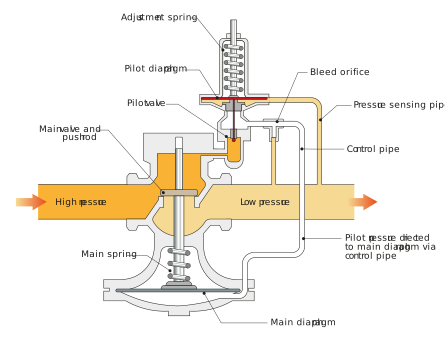
Figure: Pilot-operated pressure reducing valve
These valves provide greater accuracy and sensitivity for application where this is required. However, these valves can all fail – which brings us to the next component: pressure relief valves.
Pressure relief valves
In the event of pressure becoming too high, we must safeguard our equipment. This is why pressure relief valves are also referred to as safety valves. We can regard them as pressure reducing valves operating in reverse, meaning that they control the pressure upstream of them, which in this case is the pipe. Safety valves are always manual, which ensures that they operate under all conditions. The figure below shows a typical safety valve design.
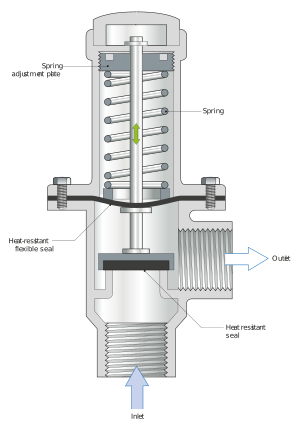
Figure: Safety valve
A pressure relief valve is spring-loaded. When the pressure is greater than the pressure the spring exerts on the seat, it will lift.
Control valves
Control valves are used to control the pressure and flow rate of steam to a user. It is important that these are correctly sized in order to provide the level of control required. The figure below shows a typical control valve.
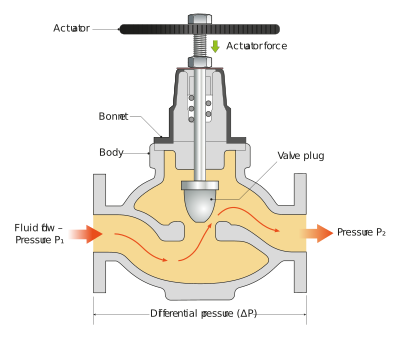
Figure: Typical single seat globe control valve
Other equipment
Another component typically found on steam lines is an air vent valve, which removes air that is trapped in the system. Air inside equipment can reduce the surface area available for heat transfer. Air also contributes to corrosion.
Vacuum breakers may also be required in situations where equipment can be closed off, full of steam, and then allowed to cool down. This effectively creates a vacuum that can damage the equipment. Vacuum breakers allow air to enter. However, this air then needs to be removed at start-up.
Insulation
Insulation is vital to reduce heat losses and save energy. This also has a safety function, as hot surfaces are dangerous. Insulation is covered in the Materials of Construction unit. It is important to consider the savings made from using thicker insulation compared to the cost. It is not practical to have fixed insulation on equipment requiring maintenance, but removable insulation provides a solution to this. An example is shown in the figure below.
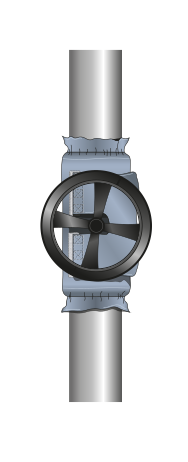
Figure: Removable insulation on the steam line
Before we move away from steam distribution, let’s consider steam metering.