
Lesson 4 - Steam Technology
This lesson takes a closer look at steam technology. It explores the generation of steam in boilers, as well as the distribution system and its components. It also considers the legal requirements associated with steam technology.
Water Supply and Treatment
The quality and supply of water is essential to the performance of a boiler. Because of the elevated temperatures, water quality issues can cause problems within a boiler such as scaling, corrosion, and foaming. It is thus absolutely essential to treat the boiler water.
The water entering the boiler comes from two sources. One is condensate returning from the process, and the other is make-up water. The make-up water should be treated before it enters the boiler process. We will cover condensate later on in this lesson, but in general, the more condensate returned, the less make-up water and water treatment is required. Returning condensate and make-up water are combined in the hotwell, which also functions as a deaerator.
Boiler water is also treated by dosing certain chemicals into the feed or into the boiler directly.
Boiler water should be:
-
Free of gases – oxygen causes corrosion and pitting of the tubes and shell. Carbon dioxide forms carbonic acid, which is corrosive.
-
Low in dissolved solids – these can cause scaling and reduce the boiler’s efficiency.
-
Foaming can also be caused by dissolved solids and other impurities. As the water is constantly evaporating, the solids are left behind in the boiler, building up over time.
-
Boiler blowdown
The build-up of total dissolved solids (TDS) in the boiler is dealt with by blowing down the boiler. Ideally, the TDS should be below 3,000 mg/L for a modern three-pass boiler. This is normally achieved by using a sensor and then conducting an automatic blowdown. Blowdown refers to dumping a proportion of the boiler contents into a vessel, or sometimes even a pit below the boiler, where it is allowed to cool before discharge to sewer (or it is reused for other purposes). The concentration of TDS in the boiler is reduced proportionately. The figure below shows a typical automatic blowdown system.
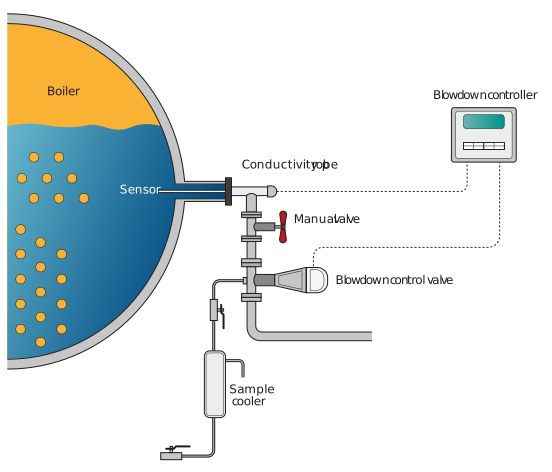
Figure: Typical blowdown system
The blowdown valve needs to ensure that there is not a drop in pressure in the boiler. Special design features can help to facilitate this. The whole control system would be fitted with a number of safety controls, for as you can imagine, a failure on this system could be quite catastrophic.
Make-up water treatment
Make-up water needs to be treated to ensure that it has low TDS, usually by deionisation or salt exchange. The latter passes the raw water through a resin bed that has sodium ions attached and will swap the calcium and magnesium ions for the sodium, hence removing them from the water. Since sodium salts are totally soluble, they do not form scale. The resin bed is regenerated with common salt – sodium chloride. Reverse osmosis can also be used.
Boiling system treatments
There are a number of chemical dosing options for boiler systems. The figure below illustrates some of these.
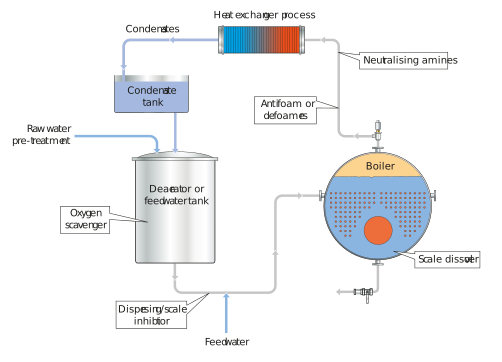
Figure: Example of boiler water treatment
Oxygen is removed by deaerators. These are normally pressure deaerators that are linked to the hotwell or membrane contactors.
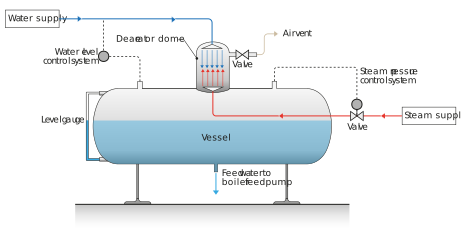
Figure: A pressure deaerator
Water is sprayed and mixed with steam. The water becomes fully saturated, which causes steam to form in the spray. This is called flashing, and it causes the oxygen to be driven off. Oxygen levels of < 20 µg/L can be achieved in this way. Oxygen scavengers such as hydrazine or sodium sulphite react with any oxygen that is left to ensure nothing is available that may cause corrosion in the boiler.
Carbon dioxide is also controlled by keeping the pH above 8.5.
Anti-scale chemicals prevent the formation of scale, and also prevent scale from adhering to surfaces.
Anti-foam chemicals prevent the formation of foam by reducing the surface tension of the water.
Now that we have covered all aspects of steam generation, let’s now look at steam distribution.