
Lesson 4 - Steam Technology
This lesson takes a closer look at steam technology. It explores the generation of steam in boilers, as well as the distribution system and its components. It also considers the legal requirements associated with steam technology.
Steam Generation: Boiler Combustion
In order for combustion to take place, we need fuel and air.
The ratio of these components is critical as too much fuel or air will affect the boiler’s efficiency. For any liquid or gaseous fuel, burners are required. Burners essentially regulate the amount of fuel added. Air is forced into the combustion chamber by means of a fan. In some boilers, the air is pushed through a combustion air preheater. This is a heat exchanger in the exhaust flue, which uses the heat from the exhaust gases to preheat the air.
Some key features of boilers are:
-
Burners can be single fuel or duel fuel. This can allow for oil and gas to be burned. In basic terms, the amount of fuel is controlled in order to maintain boiler pressure.
-
The amount of air is controlled accordingly, and an oxygen meter in the exhaust line can control the amount of air – either through a dampener or a variable speed drive on the fan.
-
Boilers have turndown ratios. This is the ratio of the minimum achievable combustion rate compared to the maximum rate.
The figure below shows a typical duel fuel burner.
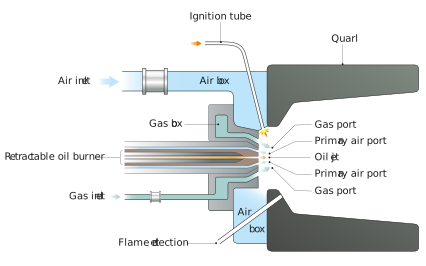
Figure: Duel fuel burner
Boiler Efficiency
Boiler efficiency is a measure of how well a boiler converts the energy released when fuel is burned into energy that can be distributed and used across the packaging facility, in the form of steam.
The energy released when fuel is burned can be defined as:

The energy available in steam that can be distributed can be calculated by:


Therefore boiler efficiency can be defined as:

Where Q is energy in kJ
Q and q
Boiler efficiency can be calculated using either Q or q. Q is the total amount of heat in joules while q is the rate of heat transfer in watts (joules per second). The difference between these is the element of time. The two are interchangeable in the above equations by using mass (in kilograms) or mass flow rate (in kilogram per second). In other words the equation above of Q = M∆H can also be represented as q = m∆H where q is the energy transfer rate and m is the mass flowrate
Let’s look at an example of how to calculate the efficiency of a boiler
A boiler generates 5 t per hour of saturated steam at 1 MPa. The boiler is fed with water at 80 °C. The boiler consumes 500kg per hour of coal. The calorific value of coal is 30 MJ/kg.
First we can calculate the rate of energy released from the fuel.

From the Mollier diagram the enthaply of water at 80°C is 340 kJ/kg
From the steam tables the enthalpy of saturated steam at 1MPa is 2,777.11 kJ/kg
We can use these to calculate the available rate of energy from the steam


Typical boiler efficiencies range between 75% - 90%. The following are some of the major factors that impact on boiler efficiency:
-
Boiler and burner design
-
Condition and adjustment of the burner
-
Type and quality of fuel
-
Air / Fuel mixture ratio
-
Heat loss to the environment
-
Blowdown amount and frequency
-
Boiler feedwater temperatures
-
Quality of steam
Now that we have covered the boiler and combustion, let’s take a look at boiler safety.