
Lesson 10 - Jacketed Vessels
This lesson explores another type of common heat transfer equipment used in brewing, namely jacketed vessels. It investigates the application, specifications, and the operating conditions of these exchangers. It also looks at their design and sizing considerations.
Considerations for Maintaining and Operating Jacketed Vessels
We have learned about jacketed vessels, their components, and how these are designed and controlled to achieve optimum heat transfer. However, to maintain this optimum performance, the jacketed vessel requires routine maintenance and proper operation.
While jacketed vessels are by design very low maintenance, there are still some important practices that are recommended to ensure they remain safe and efficient over the lifetime of the vessel. These include visual inspection and pressure testing.
Visual inspection
Although most vessels are surrounded by insulation and cladding, the exterior of the vessel can still be routinely inspected for leaks.
Pressure testing
The jacket of a jacketed vessel is actually a pressure vessel. It should thus be designed in accordance with the appropriate pressure vessel code for the country in which you operate. It will also need to adhere to the maintenance and inspection requirements of a certified pressure vessel.
The reliability and performance of the jacketed vessel is also impacted by how it is operated. Below are some considerations for good operating practices for a jacketed vessel.
Cleaning
By looking inside the vessel, it will be easy to see if the heat transfer surface is clean and free of scale or fouling. On inspection, the inside of the vessel should be shiny stainless steel, with no discolouration. If this is not the case (as shown in the figure below), the vessel’s performance will be suboptimal.
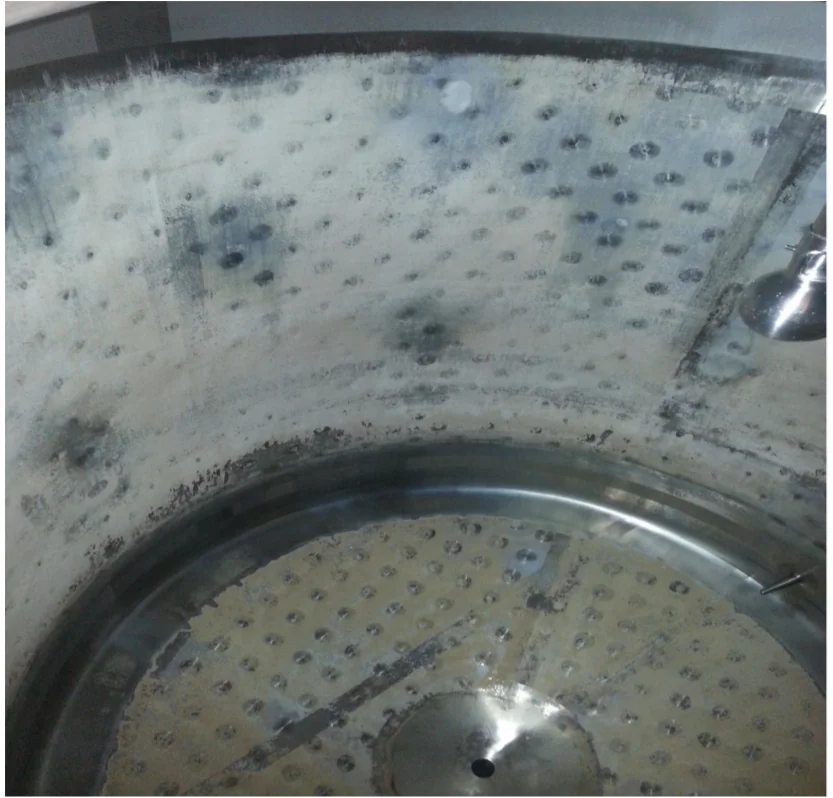
Figure: Dirty heat transfer surface of a mash vessel
Possible causes of a dirty heat transfer surface are:
-
Vessel cleaning has been ineffective due to the use of a low detergent strength, shortened cleaning time, or poor mechanical action (e.g. due to a blocked sprayball).
-
Vessel cleaning is not being carried out at the required frequency.
-
The operating level of the vessel is not adequately covering the jackets.
-
There is insufficient agitation of the product fluid inside the vessel.
-
The utilities fluid temperature is outside of the design parameters. This is most commonly seen where steam is the utility fluid and high steam temperatures cause excessive burn on the heat transfer surface.
Monitoring of utility fluid quality
As there is no way of cleaning, or indeed inspecting, the utility side of a jacketed vessel, the quality of utility fluid must be monitored on an ongoing basis. This will help to keep the vessel’s scaling and fouling potential low.