
Lesson 10 - Jacketed Vessels
This lesson explores another type of common heat transfer equipment used in brewing, namely jacketed vessels. It investigates the application, specifications, and the operating conditions of these exchangers. It also looks at their design and sizing considerations.
Dimpled Jacket
Dimpled jackets have better heat transfer rates compared with conventional jackets and are more versatile. They are a popular jacket type for large scale brewing vessels. In this section, we will learn more about this type of jacket.
Dimpled jackets are made by pressing and punching out small ‘dimples’ at regular intervals, from a thin sheet of stainless steel. These dimples are positioned at about every 50 mm. The sheet is then wrapped around the vessel, and welded to the vessel wall at each punched-out dimple. The figure below shows a vessel with a dimpled jacket.
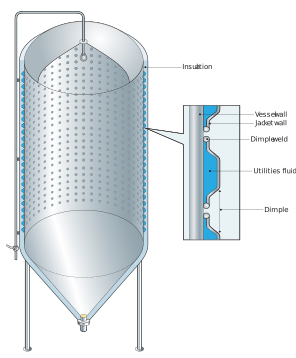
Figure: Vessel with dimpled jacket, with an insert showing dimple formation
The video below demonstrates how dimple jackets are fabricated and clearly shows the punched-out dimples in addition to where they are welded to the vessel wall. Note, this is for illustrative purposes only and is not a recommendation or endorsement of the supplier’s product.
Typical U values for dimple jackets with no agitation are 550-700 . With agitation, these can increase to between 900-1,500 .
This type of jacket has some key advantages over conventional jackets:
-
The dimples impart turbulence to the utility fluid as it flows through the jacket. This improves the effectiveness of heat transfer. This does, however, also increase pressure drop through the jacket. For a dimpled jacket with liquid utility fluid, pressure drop may limit the velocity to 0.6 ms−1.
-
Due to the strength of the dimple pattern design, dimpled jackets allow for thinner vessel shell walls than a conventional jackets. This can make the vessel, particularly larger vessels, more affordable if this design is used. It can handle higher pressure utility fluids, up to about 15 bar.
-
Dimpled jackets are very versatile. They can be used to provide heat transfer or cooling for virtually any shape or size of vessel.
Dimpled jackets, however, are not the strongest type of jacketed vessel. While completely acceptable for most applications, they are not recommended where there is thermal cycling or shock.
Let’s now look at a third type of jacket: the half-pipe jacket.