
Lesson 10 - Jacketed Vessels
This lesson explores another type of common heat transfer equipment used in brewing, namely jacketed vessels. It investigates the application, specifications, and the operating conditions of these exchangers. It also looks at their design and sizing considerations.
Control of Jacketed Vessels
In brewing, a jacketed vessel can be required to transfer heat differently at different stages of the process. Because the physical design of the vessel jackets cannot be changed, this flexibility is achieved through jacket control. Below, we will explore some examples why this control is required and how it can be achieved.
There are three reasons jacket control is required in brewing vessels:
-
Lowering the heat transfer rate
-
Managing the temperature driving force
-
Targeting the position of heat transfer
Let's look at each of these in a little more detail:
Lowering the heat transfer rate
In the previous section, we saw that jacketed vessels must be sized for the maximum required heat transfer rate. But often a jacketed vessel requires vastly different rates of heating or cooling at different process steps.
Let’s look at the example of a mash vessel.
-
During heat up from one temperature stand to another, a relatively rapid change in product temperature is required. This will most likely require the maximum (design) heat transfer rate.
-
During a temperature stand, the product temperature will tend to drop due to heat loss to the surroundings. To ensure the product fluid remains at its target temperature this heat loss needs to be replaced. In this case, supplying heat at the design heat transfer rate will cause a rapid increase in product temperature. The product temperature will likely overshoot the target, having a negative impact on the quality of the mash. In this instance the jacket control system can be used to reduce the heat transfer rate.
Managing the temperature driving force
Initially, when a vessel starts heating up or cooling down there is a large temperature difference between the product and utility fluid. This difference gets less as the vessel approaches its target temperature. You may recall that this was the case with cooling the fermentation vessel in the worked example on the previous page. We can keep the temperature difference between the utility fluid and the process fluid constant over time. This is done by changing the utility fluid’s temperature as the product temperature changes. This requires quite sophisticated equipment but does have the following benefits:
-
Where the beer or wort is temperature sensitive, reducing the initially large temperature difference will minimise damage to the product.
-
Lower temperature difference reduces the risk of fouling the heat transfer surface from burn-on or freezing.
-
If you will recall, the definition for steady state heat transfer is that the temperature difference between the product and utility fluids remains constant over time. Using jacket control to manage the temperature difference, takes an inherently unsteady state heat transfer process and controls it to steady state conditions.
-
Maintaining a constant temperature driving force reduces the peak demand on the utility fluid. This can have many advantages in managing the loading and running costs of the utilities plant in a brewery.
Targeting the position of heat transfer
Sometime, the process requires that heat transfer not occur across the entire vessel but rather be targeted to a specific section of the vessel. An example of this is in fermentation vessels, where during fermentation there is an inversion effect that occurs at around 3°C. To ensure that beer in the vessel continues to move by natural convection the position of heat transfer is different before and after this inversion point. This is expanded on a little further below.
We have looked at the reasons why jacket control is done in brewing vessels now let’s look at three ways this control can be achieved:
1. Utilities fluid flowrate
The utilities fluid flowrate can be used to manage the heat transfer rate in a jacketed vessel. This is most commonly achieved by installing a control valve on the utility supply line that varies the utility fluid flowrate. According to the heat transfer equations, q = m Cp ΔT and q = mΔHvap as the utility flowrate drops (m), so too will the heat transfer rate (q).
2. Utilities fluid temperature
Both the heat transfer rate and the temperature driving force can be managed by varying the supply temperature of the utilities fluid. If the utility fluid is a gas this is typically done by using a control valve to drop the pressure, and thereby the temperature, of the utility fluid. If the utility fluid is a liquid this is achieved by returning a portion of the outgoing utility fluid back into the incoming stream. This will raise or lower the temperature of the utility stream supplied to the jacket.
3. Multiple jackets
Multiple jackets can be used to lower the heat transfer rate as well as control the position of heat transfer in a vessel. This is evident in fermentation vessels as explained in the example below.
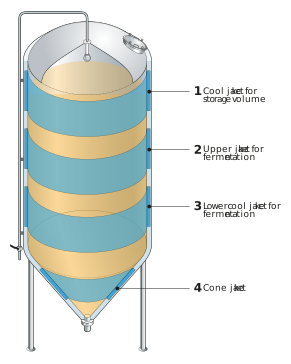
Figure: Multi jacketed fermentation vessel
Different jackets at different positions on the fermenter, will be operated at different times, depending on the required heat transfer rate and the temperature of beer.
-
During the fermentation step the heat transfer rate required is lower than the maximum the vessel is designed for. The heat transfer rate is lowered by reducing the heat transfer surface area and only activating a single cooling jacket. When the beer temperature is above 3°C (as in fermentation), the beer at the top of the tank is warmer than the bottom so cooling is required at the top of the tank. Therefore, in the fermentation step only the upper cooling jacket (area 2) is switched on.
-
In the cool down step the temperature of the beer in the fermenter needs to drop quickly, so the maximum heat transfer rate is required. This is achieved by maximising the heat transfer area of the vessel and opening all cooling jackets.
-
After the cool down, the vessel is held in a maturation step at a constant temperature. During this step the required heat transfer rate is low. This is achieved by reducing the heat transfer area and only activating a single cooling jacket. In this step, the beer temperature is below 3°C, so the warmest beer moves to the bottom of the tank. Therefore, in the maturation step just the bottom cone jacket (area 4) is switched on.
Before we leave this section it is worthwhile to look at one last point with regards to temperature control in jacketed vessels. Because of the jackets large holding volume they have a very sluggish temperature response. This means that even after the utility fluid to the vessel is shut off, the residual heat will continue to transfer for a period of time. This can result in the product fluid overshooting its target temperature.
This can be managed by closing off the utility fluid with an offset, say 0.5°C away from the target temperature. If the offset is correct, then by the time the target temperature is achieved the energy in the jackets will be fully dissipated.
Now that we have seen the various ways that jacketed vessels are controlled let’s look at some operating and maintenance considerations for jacketed vessels.