
Lesson 10 - Jacketed Vessels
This lesson explores another type of common heat transfer equipment used in brewing, namely jacketed vessels. It investigates the application, specifications, and the operating conditions of these exchangers. It also looks at their design and sizing considerations.
Types of Vessel Heating and Cooling
This lesson focuses on jacketed vessels because in most large scale breweries, this is the method used to transfer heat when beer or wort is held in a vessel. However, there are other technologies used for heating or cooling a fluid in a vessel that also have application in the brewing process. In this section, we will introduce you to two of these.
Internal heating coils
The simplest way to transfer heat to a fluid inside a vessel is to fit it with an internal coil. A long, thin pipe is twisted into a coil shape and then fitted inside the vessel. When the vessel is filled, the coil is immersed in the product fluid. The utility fluid is pumped through the coil, and heat is transferred between this and the product fluid, through the wall of the tube coil.
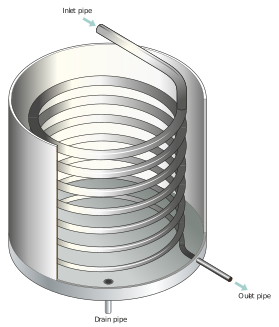
Figure: Vessel with internal coil
Because the utility fluid is pumped through a narrow pipe it typically has a high velocity and therefore, internal coils offer excellent heat transfer coefficients. Typical overall heat transfer coefficients for internal coils are between 800-1200 Wm-2K-1.
Vessels with internal coils are most popular in small scale brewery applications, as shown in the figure above. Because the vessel is small, the coil can be easily removed for vessel cleaning. Internal heating coils are also commonly used in water and CIP tanks where vessels do not need to be cleaned as frequently.
External heat exchanger
With this technology, wort or beer is pumped out of the vessel, through an inline heat exchanger, and is returned to the vessel. This in turn raises or lowers the bulk temperature in the vessel. The heat exchanger used is a plate exchanger or a shell and tube exchanger (we explored these in the previous lesson on Heat Exchangers).
External heat exchanger systems have far better heat transfer rates than jacketed vessels or internal coils, and they do not have the same surface area constraints. A common example is the modern day wort kettle (shown in the figure below). Historically, wort kettles were heated using direct fire or steam jackets, but they now all use either internal or external heat exchangers, also known as calandria.
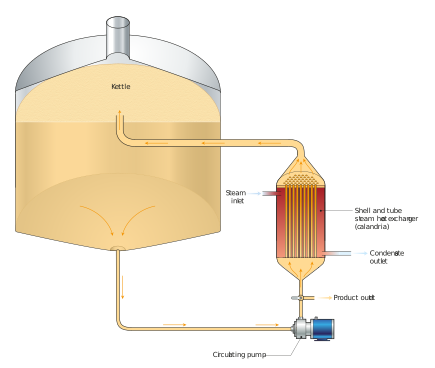
Figure: Vessel with external heat exchanger
With more recent industry developments, external heat exchangers are even being used in fermentation to supplement or replace the cooling provided by the jackets of the fermentation vessel. While this technology can significantly reduce energy costs, there are limitations that currently restrict its uptake:
-
High capital and maintenance costs
-
Increased risk of product loss and contamination
-
Increased sheer forces on the wort or beer from additional pumping
You now have an overview of the different ways that vessels are heated or cooled in a brewery, and their applications. The remainder of this lesson will focus on the design and operation of jacketed vessels. However, the concepts and examples given can also be applied to heating using internal coils or an external heat exchanger.