
Lesson 10 - Jacketed Vessels
This lesson explores another type of common heat transfer equipment used in brewing, namely jacketed vessels. It investigates the application, specifications, and the operating conditions of these exchangers. It also looks at their design and sizing considerations.
Half-Pipe Jackets
Half-pipe jackets are durable, have better heat transfer rates than the other jackets, and are popular for high pressure applications. In this section, we will learn more about this type of jacket.
Half-pipe jackets are fabricated by taking a pipe and cutting it in half along its length. As shown in the figure below, this half-pipe is then wound around the outside of a vessel in a helix, and welded into place.
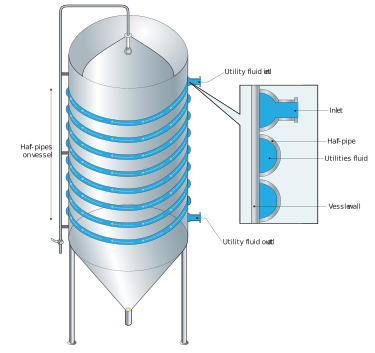
Figure: Vessel with a half-pipe jacket
The heat transfer area will be the total area of the half-pipe that is in contact with the wall of the vessel. It is determined by the diameter of the half-pipe and the pitch of the coils. Usually, standard pipe sizes ranging from 60-120 mm are used.
Typical U values for half-pipe jacketed vessels, with no agitation, are 750-950 Wm-2 K-1. With agitation, these can increase to between 1,200-1,700 Wm-2 K-1.
Half-pipe jackets have the following advantages when compared to conventional and dimple jackets:
-
They offer the most affordable solution for high pressure utility fluids.
-
The tubes increase the velocity of the utility fluid, thereby giving half-pipe jackets the highest overall heat transfer coefficient of the three jacket types presented. For a half-pipe jacket with liquid utility fluid, a minimum target velocity of 2.3 ms−1 should be considered.
-
The tubes provide strength to the vessel wall, thereby reducing the cost of the vessel. This strength also makes them well-suited to applications involving large temperature changes.
-
In half-pipe jackets there can never be any short circuiting of the utility fluid. In other jacket types this can also be achieved but only with very good jacket design. Half-pipe jackets are the only jackets that will never have this issue regardless of how they are designed.
Limitations of half-pipe jackets include:
-
Even less available surface area than conventional or dimple jackets
-
The large amount of welding on the vessel wall can cause mechanical weakening of the vessel
-
Jacket welding must not interfere with the welding of the vessel wall; this maintains mechanical integrity
You are now familiar with the three most common jacket designs that you may find in a brewery. In the next section, we will look at some of the other common features of jacketed vessels that can improve overall heat transfer.