
Lesson 10 - Jacketed Vessels
This lesson explores another type of common heat transfer equipment used in brewing, namely jacketed vessels. It investigates the application, specifications, and the operating conditions of these exchangers. It also looks at their design and sizing considerations.
Conventional Jackets
There are three main types of jacket designs found in brewing applications: conventional, dimple, and half-pipe jackets. In this section, we will review the features of the first of these: the conventional jacket.
In conventional jacketed vessels, a second shell is installed around a portion of the vessel. This creates an annular space within which the utility fluid flows. The utility fluid circulates between the jacket and the vessel wall, and heat is transferred through the wall of the vessel to the fluid in the vessel. The space between the jacket and the vessel can range from 50 mm to 300 mm.
To improve the utility fluid velocity, turbulence enhancing devices are installed inside the jacket. These could be baffles that direct flow in a spiral pattern around the jacket, or agitating nozzles that cause high turbulence at the point where the fluid is introduced into the jacket. For a conventional jacket with a liquid utility fluid, the target velocity through the jacket should be 1-1.5 ms−1.
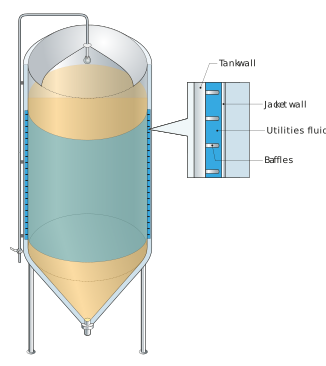
Figure: Conventional jacketed vessel with inserts showing jacket baffles
The figure below shows some typical overall heat transfer coefficients for different conventional jacket designs.
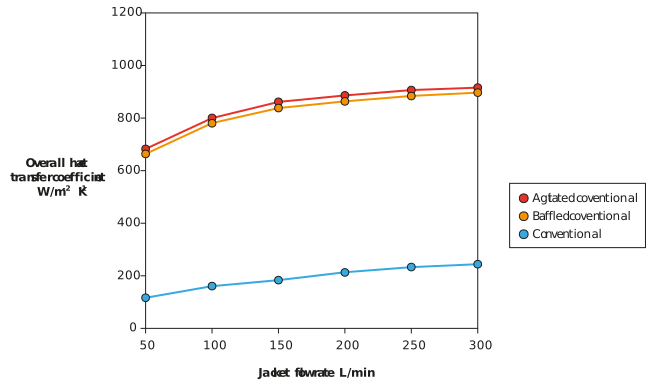
Figure: Typical overall heat transfer coefficients for conventional, agitated conventional, and baffled conventional jackets
When either agitation or baffles are introduced to conventional jacketed vessels, the overall heat transfer coefficient improves significantly.
Compared with other jacket designs, conventional jackets have the following advantages:
-
They offer the maximum available heat transfer area
-
They are very simple to fabricate
-
They are very affordable for smaller vessels (usually < 400 L)
-
They have a low pressure drop through the jacket
They also have the following disadvantages:
-
For larger vessels, the jacket material needs to be quite thick to maintain the jacket’s strength. This makes them cost-prohibitive for larger vessels.
-
They are not well-suited to pressure applications above 3.50 bar.
Let’s now look at another type of jacket: the dimpled jacket.