
Lesson 10 - Jacketed Vessels
This lesson explores another type of common heat transfer equipment used in brewing, namely jacketed vessels. It investigates the application, specifications, and the operating conditions of these exchangers. It also looks at their design and sizing considerations.
Point of Reflection – Reconvene
Welcome back. So, what were your thoughts?
Examples of vessels being used as heat exchangers in brewing include:
-
mash vessels;
-
cereal cookers;
-
wort kettles;
-
yeast propagation, storage and pitching vessels;
-
fermentation vessels;
-
maturation vessels; and
-
bright beer tanks.
Vessels can also be used as heat exchangers where beer or wort is not the product stream, such as hot and chilled water tanks, and cleaning in place (CIP) tanks. In these examples, even though the product stream is not beer or wort it is still referred to as the product fluid.
In some of the examples listed above the process requires the product fluid to be heated up or cooled down. However, there are also examples where the vessel is simply used to maintain the temperature of the product inside. In this case heating (or cooling) of the vessel is required simply to replace (or remove) heat that has been lost to (or picked up from) the environment.
In large scale breweries, the most popular way to heat or cool beer or wort inside a vessel is to use a jacketed vessel. This is a vessel, containing product, that is enclosed within a jacket. The utility fluid is pumped through the jacket and heats up or cools down the content of the vessel through the vessel wall. The figure below shows an example of a jacketed vessel being used as a fermentation vessel.
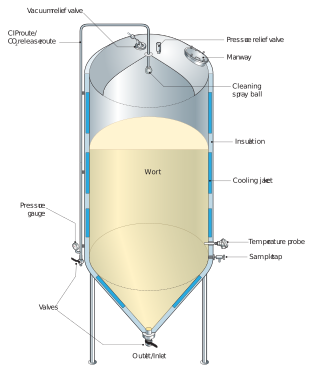
Figure: Internals of a typical jacketed vessel
Because there is no heating or cooling equipment inside the vessel, jacketed vessels are well-suited for applications where frequent cleaning is required, such as brewing.
Jacketed vessels, however, have a limited heat transfer surface area and low heat transfer coefficients. Later in this lesson, we will look more closely at the measures taken in the design of jacketed vessels to lessen these shortcomings.
In the brewing process, heat transfer in jacketed vessels can be either steady or unsteady state, depending on the process application. This lesson will expand on these concepts and show how they are used in the design and sizing of jacketed vessels.
In addition to jacketed vessels, there are two further ways that wort and beer in a vessel are heated or cooled. Let’s look at these and describe them.