
Lesson 2 - Principles of Heat Transfer and Conduction
This lesson deals with the principles and application of a form of heat transfer called conduction. More specifically, we look at definitions, typical values for some important constants, and brewery-specific conduction examples.
Conduction
As we previously learned, when heat is transferred between two objects in contact with one another, we call it conduction.
The steady state rate of heat transfer through a single layer of material is defined by Fourier’s law, represented by the equation:

Where
q is the required amount of heat flow, measured in J s-1 (W)
A is the surface area, measured in m2
k is the thermal conductivity, measured in W m-1 °C-1
∆T = T2 − T1 is the temperature drop across the layer, measured in °C
∆x = x2 − x1 is the thickness of the layer starting at x1 and ending at x2, measured in m.
Let us have a closer look at one of these components – thermal conductivity.
This equation results in the heat transfer rate in units of energy rate per surface area, or W m-2. It is often reported and used with area on the other side of the equation as seen below. When the surface area is known, this equation should be used which results in the heat transfer rate in units of W.

Thermal conductivity
Thermal conductivity, k, is a physical property of a material which describes how easily heat will flow through it. The SI unit for thermal conductivity is W m-1 °C-1. Here are some thermal conductivity values for common heat transfer materials:
Stainless steel: 17 W m-1 °C-1
Mild steel: 45 W m-1 °C-1
Copper: 380 W m-1 °C-1
Silver: 415 W m-1 °C-1
In general, the higher the thermal conductivity of a material, the better it is at transferring heat. Based on the values listed above, we can see that copper allows heat to transfer more effectively than stainless steel.
When a material is good at conducting heat, we call that material a conductor. When a material is resistant to or not very good at conducting heat, we call that material an insulator.
Some examples of good conductors in a brewery are steel and copper. Some examples of good insulators in a brewery are water, plastic, air, and mineral wool – which is found in the insulation surrounding pipes. A common everyday example which illustrates conduction and insulation properties is a frying pan. The pan itself is typically made from a good conductor metal like steel or iron, which allows heat to travel from the stove through the pan and to the food. The handle is usually coated with a plastic that will not allow heat to travel through it, so we can hold it while cooking without burning ourselves.
It should be clear now that if we want heat to travel through a material and to heat another material, then all the materials need to be good conductors and have a high thermal conductivity. However, if we want to keep heat contained and reduce the loss of heat to the atmosphere, then we require a good insulator.
Next, we will look at two different scenarios where Fourier’s law can be applied.
Fourier’s law applied to a single layer
The figure below shows a simple example of conduction through a single layer.
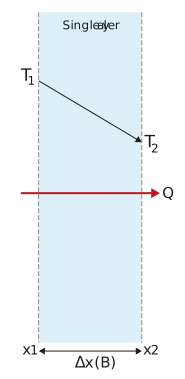
Figure: Conduction through a single layer
Here, we have heat flow through a single layer, perhaps a stainless steel plate. At the beginning of the plate at x1 we have temperature T1. At the end of the plate at x2 we have temperature T2. Fourier’s law can be used to calculate q, the rate of heat transfer through the plate.
Let us assume that T1 is 65°C, T2 is 50°C, and the thickness of the stainless steel plate is 4 cm and a surface area of 1.5 m2. If the thermal conductivity of stainless steel is 17 W m-1 °C-1, what is the rate of heat flow through the plate? To determine this, recall Fourier’s law for steady state rate of heat transfer by conduction:
We can simply enter the values.

Note that the answer is negative because the heat is being lost, this is evident because the temperature decreases from one side of the plate to the other.
If we know the entire area of the plate, we can also calculate the heat flow rate in W. Let us assume the area of the plate is 1.5 :

Fourier’s law applied to multilayer systems
In the example above, we had one single layer to account for. We calculated the heat flow through the plate given the one single layer of resistance. Thermal resistance is a measure of a temperature difference by which an object or material resists heat flow. The resistance is dependent on the material thermal conductivity, k, the plate thickness, B, and the area of the heat transfer, A. Mathematically we can write this as:

If we substitute this formula for thermal resistance into the Fourier equation, it will look like this:

For each layer of additional resistance, we have an additional resistance term. The figure below shows a three-layer system.
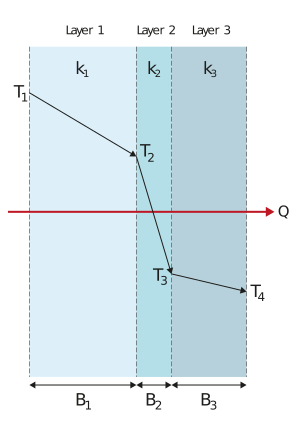
Figure: Conduction through a three-layer system
Here, we have three layers of resistance with different thicknesses, thermal conductivity, areas, and initial and final temperatures. To calculate the heat flow through the entire system, we can modify Fourier’s law:

Where


In a brewery, this example is seen in a pipe with insulation. Adding an additional layer of insulating material around a pipe adds another layer of resistance for heat to flow out of or into the pipe.
Insulation increases thermal efficiency by reducing the heat that is lost or absorbed.
As heat flows radially through a pipe, Fourier’s law needs to be modified to account for the geometry of the pipe.
Fourier’s law applied to pipes
Heat transfers from hot to cold in the direction that is normal to the heat source. Normal means in the direction that makes a 90° angle to the surface. In a pipe, heat transfers from the centre out towards the surface of the pipe. Consequently, temperature varies in a radial direction, i.e. if the fluid is hot, the hottest part is in the centre and it gets cooler towards the outside of the pipe. The figure below shows the temperature gradient in an insulated pipe.
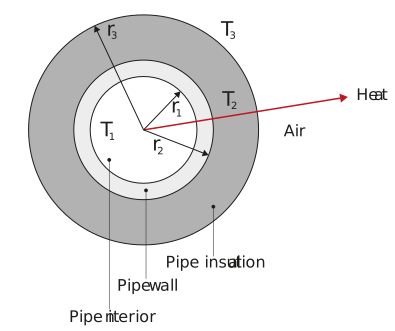
Figure: Heat flow out of an insulated pipe
Let us examine the figure above.
-
The area A is the actual pipe.
-
The inner radius of the pipe is r1, which is the length from the centre of the pipe to its inside wall.
-
The outer radius of the pipe is r2, which is the length from the centre of the pipe to its outside wall.
-
T1 is the temperature of the fluid or gas inside the pipe.
-
The area B is the insulation with temperature T2.
-
The outer radius of the insulation is r3, which is the length from the inside of the pipe to the outside of the insulation.
-
Lastly, the temperature on the outside of the pipe is T3.
If there is hot liquid, say wort, flowing through a pipe, there will be some heat loss from the liquid through the pipe walls and into the atmosphere. Recall from earlier that the general equation for heat flow by conduction is Fourier’s law:

The area of heat transfer in a pipe is the log mean area of the pipe, defined as:

Where L is the length of the pipe, Ai and Ao are the inside and outside surface areas and r1 and r2 are, respectively, the inner and outer radius of the pipe r1 r2.
The thickness of the pipe is the outer radius minus the inner radius, or r2 − r1.
If we enter the log mean area and the pipe thickness into the Fourier equation, we get the following for the flow of heat through a pipe wall:

Where
q is the heat flow in the pipe, measured in J s-1 (W)
k is the thermal conductivity of the pipe material, measured in W m-1 °C-1
L is the length of the pipe, measured in m
∆T = T1 − T2 is the temperature drop across the layer, measured in °C
r2 is the outside radius of the pipe, measured in m
r1 is the inside radius of the pipe, measured in m.
If the pipe is insulated, an extra step is necessary because we need to account for the heat resistance of the insulation as well as the piping material. The equation for heat loss through an insulated pipe is:

Where
r3 is the outside radius of the insulation, measured in m
k3 is the thermal conductivity of the insulation, measured in W m-1 °C-1.
Let us combine what we have learned about Fourier’s law into a worked example before we finish the lesson.
Fourier’s law example
Let us calculate the heat loss from a 3 m length of stainless steel pipe from the wort kettle to the whirlpool in a brewery. The wort inside the pipe is 100°C. The temperature on the outside surface of the pipe is 93°C. The inside radius of the pipe is 5 cm and the outside radius is 5.8 cm.
First, we decide which equation to use. We are using a pipe without any layer of insulation, so we can use the following equation derived above:
Recall that the thermal conductivity of stainless steel is 17 W m-1 °C-1. We need to convert the pipe radius from cm to m. There are 100 cm in 1 m, so the inner radius is 0.05 m and the outer radius is 0.058 m. The only thing left to do is to enter the values and calculate.

This number is negative because it is heat being lost or exiting the system.