
Lesson 2 - Principles of Heat Transfer and Conduction
This lesson deals with the principles and application of a form of heat transfer called conduction. More specifically, we look at definitions, typical values for some important constants, and brewery-specific conduction examples.
Preface
Heat can be transferred between objects in different ways. In this Heat Transfer unit, we will discuss the three main ways that heat is transferred between matter: conduction, convection, and radiation (combined). In this lesson, we will introduce ‘heat’ and how it is transferred but we will focus on conduction. Convection and radiation (combined) are covered in later lessons in this unit.
Heat
Heat (Q) is transferred in a brewery at many different stages, e.g. in the wort kettle during the wort boiling step of the brewing process, and also when cooling this wort in preparation for fermentation. A heat exchanger uses heat transfer principles to transfer heat from boiling wort to cooling water so we can have wort at the correct temperature for pitching yeast. Heat exchanger technology is covered later in this unit.
Heat is a form of energy and thus is measured in the same units as other forms of energy like chemical, nuclear, electrical, radiant, light, motion, sound, elastic, and gravitational energy. The SI unit for energy in the form of heat is the joule (J).
In some industries and applications, the calorie is used as a unit of heat.
Nature of heat flow
When heat is produced in a reaction we call it an exothermic reaction. Most of the reactions that happen in a brewery are exothermic. Perhaps the most well-known example of an exothermic reaction in the brewery is fermentation. This can be observed by the increase in temperature from the beginning to the end of fermentation.
When heat is absorbed by reaction, we call it an endothermic reaction. An example of an endothermic reaction is photosynthesis. Plants absorb energy from the sun to convert carbon dioxide and water into glucose and oxygen, and the overall reaction absorbs heat energy from the outside atmosphere.
One very important property of heat is that it always flows from an object of a higher temperature to one of a lower temperature.
There are two forms of heat energy that are common in a brewery – sensible and latent. It is important to know the difference when discussing heat transfer.
Sensible heat
Sensible heat is best described as the heat you can feel or see. When the temperature of an object changes, sensible heat has been exchanged. Think about the wort heating in a wort kettle. Some form of heat, whether steam, gas, or electric energy, is being applied to the kettle, and consequently we see an increase in the temperature of the wort.
Latent heat
Latent heat is a little more difficult to comprehend. It is the energy absorbed or released from a substance during a phase change. Let us go back to our wort kettle example. When we reach the boiling state, heat is still being supplied to the kettle, but the temperature does not increase past the boiling point. Instead, we see vaporisation of the wort. The energy being supplied to the kettle is being used to vaporise the wort instead of changing its temperature. The figure below shows the difference between sensible and latent heat.
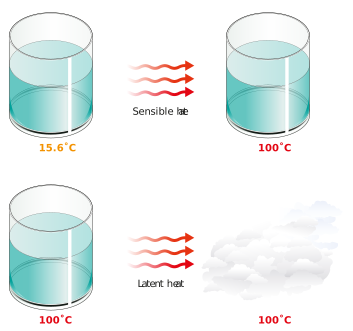
Figure: Sensible and latent heat
Sensible and latent heat are both found in a brewery and are important concepts to understand and quantify. We discuss them in more detail in the next sections.