
Lesson 2 - Principles of Heat Transfer and Conduction
This lesson deals with the principles and application of a form of heat transfer called conduction. More specifically, we look at definitions, typical values for some important constants, and brewery-specific conduction examples.
Mechanisms of Heat Transfer
Now we understand the different types of heat energy, let us discuss the ways heat is transferred between objects and substances.
Heat is transferred in three main ways – conduction, convection, and radiation.
Conduction
Conduction is when heat is transferred between two objects in contact with each other. More scientifically, it involves the transfer of kinetic energy from one atom or molecule to another without bulk mixing. This kinetic energy is transferred as heat. You may recall that heat always travels from high temperature to low temperature. A common brewing example of conduction is the transfer of heat through the wall of a steam jacket. Steam carries heat, the heat travels through the wall via conduction so it can heat the contents of the vessel. We will discuss heat conduction in more depth at the end of this lesson.
Convection
In convection, heat is transferred by mixing, and the process can only take place in fluids – liquids and/or gases.
You may have heard that heat rises in air. This is because the density of air decreases as it becomes warmer. So, the less dense the air, the lighter it is and it consequently moves upwards.
Convection happens when warmer areas of liquid or gas rise to cooler areas of liquid or gas. The constant cycle of warmer air to cooler air causes a circular motion of air or liquid. This is an example of natural convection.
Ovens use heat transfer in the form of convection to cook food. Conventional ovens use a heating element that heats the air in the oven, which then transfers the heat to the food. This is an example of natural convection. Convection or fan ovens have a fan and an exhaust system that circulate hot air throughout the oven, promoting a uniform temperature and faster cooking. This is an example of forced convection.
An example of natural convection in a brewery is an internal calandria inside the wort kettle.
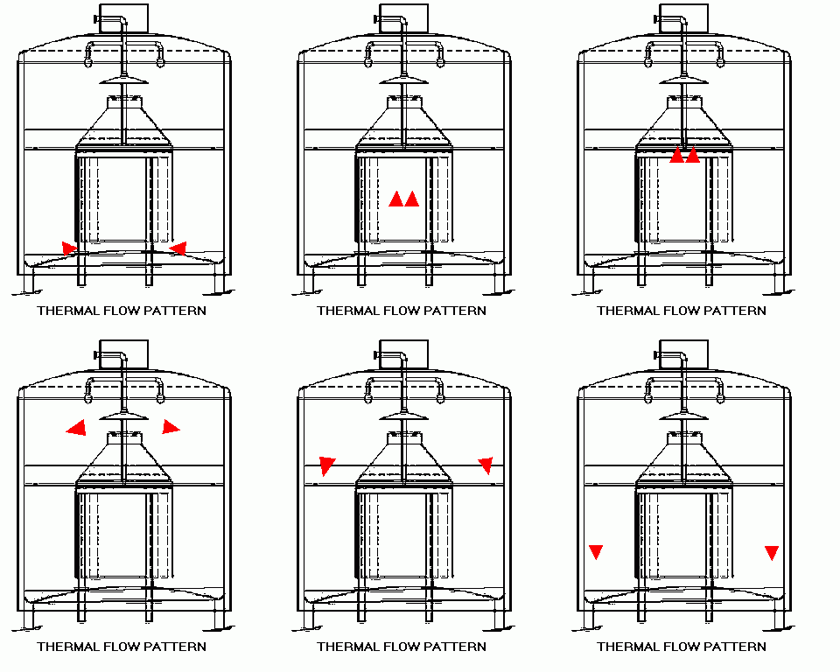
Animation: Thermal flow pattern within an internal calandria
In an internal calandria, steam is fed through a set of tubes. The wort can flow freely in the wort kettle and touches the outside surface of the tubes. Heat then flows from the steam and heats the tubes. It then travels through the tubes which are in contact with the wort, which is consequently heated. The wort in contact with the hot tubes heats up first and travels upwards, replacing the cooler wort above, which circulates downwards in the centre of the wort kettle. This process occurs continuously and creates a circular movement of the wort contents in the kettle, promoting mixing and high efficiency heating. We will discuss convection more in a separate lesson in this unit.
Radiation
The last type of heat transfer is radiation. You may be picturing the sun or a microwave when you hear ‘radiation’, and that is correct. While conduction and convection require matter (a solid, liquid, or gas) to transfer heat, radiation does not rely on contact between the heating element and heated substance. Instead, radiation is heat travelling through electromagnetic waves. When electromagnetic waves come into contact with a surface, they can be absorbed, emitted, or reflected. When the waves are absorbed, it is done in the form of heat.
For example, the energy from the sun is transferred via thermal or infrared radiation waves. Another example is the heat you feel from a burning campfire.
Combined
Most heat transfer is not via just one mode but rather a combination of all three. The figure below illustrates this.
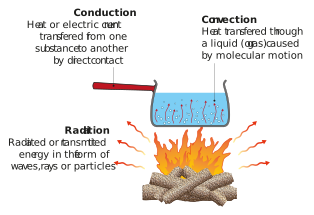
Figure: Cooking over a campfire – demonstration of combined heat transfer