
Lesson 2 - Principles of Heat Transfer and Conduction
This lesson deals with the principles and application of a form of heat transfer called conduction. More specifically, we look at definitions, typical values for some important constants, and brewery-specific conduction examples.
Exothermic and Endothermic Reactions
All chemical reactions either absorb or release heat. If a reaction releases heat, it is exothermic. If a reaction absorbs heat, it is endothermic. The figure below shows the difference between exothermic and endothermic reactions.
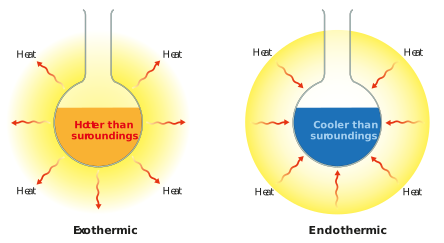
Figure: Exothermic versus endothermic reaction
A classic example of an exothermic reaction in a brewery is fermentation. During fermentation, yeast converts glucose into ethanol and carbon dioxide and releases heat in the process. Jacketed fermenters are often used to control the temperature during fermentation.
The amount of heat released by fermentation is dependent on properties of each substance being broken down or created in the chemical reaction. These properties are then used to calculate ‘heat of formation’. This concept is beyond the scope of this lesson, but for now just know that these values are used to determine the amount of energy involved in a chemical reaction.
Through experimental studies and more involved calculations, it has been reported that the heat generated from fermentation is about 586 KJ Kg-1 extract fermented. So, for every kg of sugar the yeast consumes, 586 KJ of energy is released as heat. Let us explore this a little more with another worked example.
When designing a fermentation cellar, you need to know how much heat will be generated from each fermentation. The amount of heat generated from a fermentation is used to determine how much cooling will be required so that the fermentation can remain near the desired fermentation temperature.
Let us do a brewery example.
We have transferred 7,467 kg wort from our previous examples into the fermenter. The original wort concentration was 12.5°P. After fermentation is complete, the wort concentration is 2.5°P. This results in 746 kg sugar fermented. We can use the value given above of 586 KJ Kg-1 to determine how much heat was generated.

With this value, we can conclude that to keep the fermentation temperature constant we need to remove 437,156 kJ of heat throughout the fermentation.