
Lesson 4 - Gas Transfer
This lesson focuses on transferring gases into and out of solution. It looks in particular at carbon dioxide dissolution in water and beer, and explores how to manipulate pressure, temperature, and gas composition to influence the saturated gas concentration (as well as the rate of gas transfer). It also looks at some tabulated data that are widely used in the industry. The lesson concludes by describing gas transfer technology.
Super-Saturation
To date we have considered solubility concentrations at equilibrium, or saturation, as a function of the pressure and temperature. However, under certain conditions, we can create concentrations greater than saturation for a given pressure and temperature. In fact, brewers rely on these conditions every time a consumer opens a can or bottle of beer and pours the beer into a glass. Let’s now look at the super topic of…super-saturation!
Super-saturation of a gas dissolved in a liquid is where the dissolved quantity of gas is above the equilibrium conditions for that temperature and pressure. You have probably come across the concept of super-saturation of solids in liquids before in either the chemistry laboratory or the kitchen. For example:
-
Super-saturation of solutions in the chemistry laboratory, where we dissolve solids into a liquid at high temperature and then reduce the heat of the solution until the solution becomes super-saturated and crystallisation of the solid occurs. Maybe you grew copper sulphate crystals on a thread in this way at school?
-
Super-saturation of solutions in the kitchen, where we dissolve sugar into hot water and then cool the solution down to get a super-saturated solution and then introduce a string to get sugar crystals to grow on it to form rock candy.
In order for dissolved gas in a liquid to come out of solution (‘gas break out’) the solution either must be, or must become, super-saturated with the gas. In other words, a situation must arise where the concentration of dissolved gas exceeds the equilibrium concentration for the prevailing pressure or temperature, or the local pressure falls below (or temperature rises above) the equilibrium level for the gas concentration in solution. The solution is then above saturation level, or ‘supersaturated’.
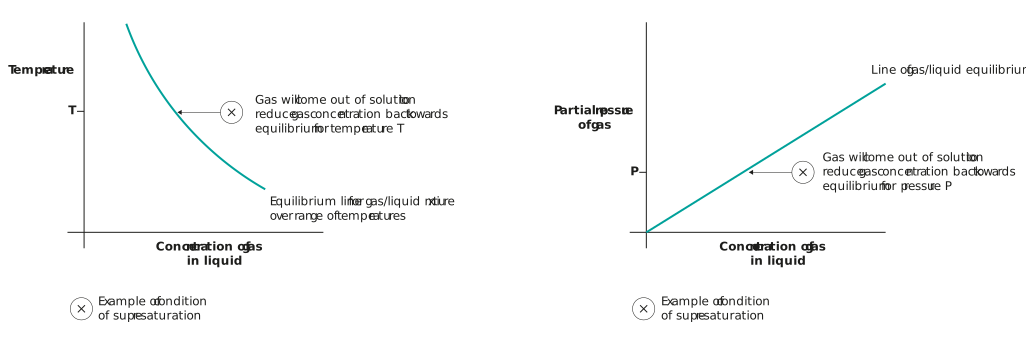
Figure: Supersaturation conditions
In either case, the end result is that the liquid holds more dissolved gas in solution than it would otherwise do for the pressure/temperature conditions and the liquid will try and reduce the gas concentration by either of the following two mechanisms:
-
Slow diffusion (transfer of the dissolved gas component from the liquid surface into the headspace) until equilibrium is reached. This can in general only happen under controlled laboratory conditions.
-
Formation of gas bubbles (nucleation), transferring the dissolved gas from the liquid phase into the headspace. This process creates quite a rapid return to equilibrium conditions and can be dramatic at times. It is unwanted if experienced during beer processing, (also known as gas breakout, or the beer ‘going wild’ during container filling) but is highly desirable when dispensing beer into a glass as the presence of bubbles supports beer foam and beading (another word for nucleation) in the glass. We will discuss this in more detail shortly.
If the deviation from equilibrium concentration is sufficient (i.e. there is a sufficient level of super-saturation), gas breakout will occur, and this requires both bubble nucleation and bubble growth.
Bubble nucleation may either be homogeneous nucleation (from microbubbles within the liquid itself) or heterogeneous nucleation (which is generally from pre-existing cavities or imperfections on a surface, or minor particles within the liquid, which act as nuclei).
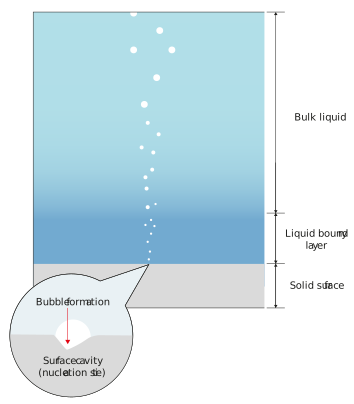
Figure: Heterogeneous nucleation
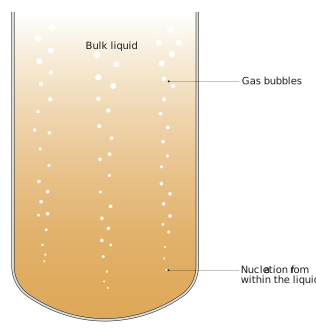
Figure: Homogeneous nucleation
Virtually all bubble nucleation encountered in the brewing industry is heterogeneous and this requires a lower activation energy compared to homogeneous nucleation. In practical terms, this means that, with heterogeneous nucleation, there is more nucleation and bubble formation arising for a given level of supersaturation (whether by gas concentration or temperature).
The mechanism of bubble growth is by diffusion of the gas from the liquid phase through the liquid/gas boundary layer at the interface. The rate of bubble growth is determined by the hydraulic conditions at the interface of the gas and liquid (i.e. the nature of the respective boundary layers, the thicknesses of which are inversely related to the degree of turbulence on the gas or liquid side).
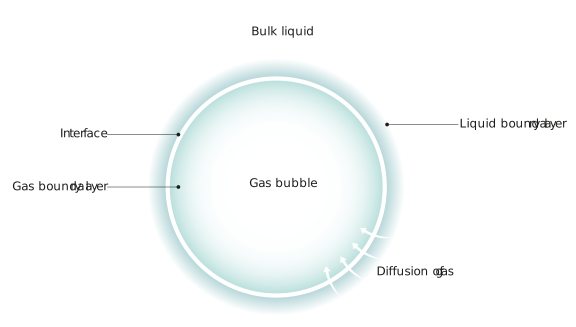
Figure: Bubble growth
For example, the growth of bubbles from nucleation sites on the side of a glass of beer will be relatively slow, compared to the extremely rapid gas break out in the turbulent flow of a super-saturated product during processing, e.g. in a venturi or other restriction.
Practical situations in which unintended gas break out occurs in beer processing include:
-
When a constriction such as a valve or in-line instrument causes a short-term drop in local pressure to create the conditions of super-saturation.
-
Where a pump operates under cavitation conditions (as described in the Fluid Mechanics unit) when the pressure at the pump inlet (impeller) falls below the saturation pressure for either a dissolved gas, or the vapour pressure of the fluid itself exceeds the local pressure.
How easy it is to get the gas back in solution depends on:
-
The downstream pressure and temperature conditions – higher pressure or lower temperature will help
-
The degree of turbulence downstream, and the potential to increase this without the quality impact discussed below.
-
The solubility of the gas (e.g. carbon dioxide is around 100 times more soluble than oxygen at the same temperature and pressure).
If unrectified, quality or processing problems can occur downstream including unwanted foaming, poor heat transfer through heat exchangers, instrument sensor function, and an unreliable gas concentration in the product.
However, controlled gas breakout is highly desirable in beer dispensing – the systems are designed to deliberately allow some gas break out for head formation in the glass.
One scenario the brewer is often faced with is how to reduce the dissolved CO2 gas level in an over-carbonated bulk product. The best approach would be to reduce the head pressure in the vessel over the required timeline in order to reach desired gas concentration. If done too quickly, possibly aided by agitation or circulation (or banging the side of the tank with a mallet!) dangers arise, particularly in very bright filtered products in which beer fob can form that then collapses into the beer, resulting in a collapsed fob particulate haze – which is undesirable post-filtration.
Alternatively, the beer can be transferred back into a tank at a lower head pressure, pre-filtration and then refiltered.