
Lesson 4 - Gas Transfer
This lesson focuses on transferring gases into and out of solution. It looks in particular at carbon dioxide dissolution in water and beer, and explores how to manipulate pressure, temperature, and gas composition to influence the saturated gas concentration (as well as the rate of gas transfer). It also looks at some tabulated data that are widely used in the industry. The lesson concludes by describing gas transfer technology.
Gas Transfer
The transfer of gases into and out of liquids is a critical part of brewing. After all, who wants a flat beer, or an over-carbonated one? And from your previous studies you are probably already aware that great care is taken to reduce dissolved oxygen levels in the water used to dilute high-gravity beer due to its negative impact on beer flavour. The governing equations which relate pressure, temperature, and dissolved concentrations of gas are based on the gas law concepts which we looked at in a previous lesson. It is now time to pull them all together so you can apply them to control the dissolved gas levels in your products.
Dissolved gases
The need to control dissolved gas levels is commonplace throughout the brewing process. Examples include:
-
Oxygenation of wort prior to fermentation
-
Control of beer carbonation levels during fermentation
-
Carbonation of bottle-conditioned beer
-
Carbonation and nitrogenation levels in draught lagers and ales
-
Removal of dissolved oxygen in dilution water
You can see that we are interested not only in adding gases into solutions, but also in removing dissolved gases from solutions.
Let’s now look at the concept of a liquid being saturated with a gas.
Saturation and Henry’s law
Let’s consider a liquid, for example water, which is initially completely free of dissolved gases and is held within a vessel with a headspace. We fill the headspace of the vessel with a gas at a pressure P, let’s say pure carbon dioxide, as shown in the figure below.
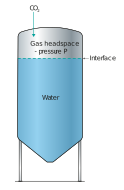
Figure: A vessel of water in contact with a CO2 headspace
As time passes, CO2 will start to dissolve into the water such that the dissolved CO2 concentration will increase, and given enough time, a final steady-state value of dissolved CO2 concentration will be achieved (one that does not change with time). This behaviour would look something like that shown in the figure below.
Please note that this representation is a little simplified as, in reality, on both gas and liquid sides of the interface there is a boundary layer, across which a gas concentration gradient will exist. In general, in such a situation (i.e. undisturbed liquid and gas) it will be the liquid boundary layer that provides most resistance to gas transfer and will control the rate of transfer. The result, however, will be as shown below, but the means to reduce the time to get there will be given more consideration later in the lesson.
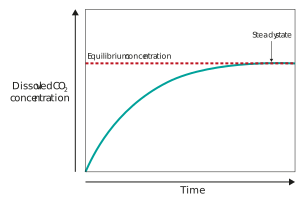
Figure: Plot of dissolved CO2 concentration against time
At the point when the dissolved CO2 concentration reaches steady state, the CO2 dissolved in the water and CO2 headspace gas are said to be in dynamic equilibrium with one another. That is, as a molecule of CO2 starts to dissolve into the water, then simultaneously a molecule of CO2 begins to come out of solution and re-enters the headspace.
We can also think of this another way; the water is saturated with CO2 for the particular set of pressure and temperature conditions that exist. If we increase the pressure of the headspace gas, the effect is to ‘force’ more gas into solution at equilibrium such that the equilibrium concentration increases. (This may not be news to you, as you may be familiar with the ‘forced carbonation’ of beer in a keg by applying a moderate headspace pressure of CO2 to force the CO2 into solution.) Such observations were made by William Henry, who proposed what became known as Henry’s law.
Henry’s law is a mathematical proportionality (at a given temperature) between the partial pressure of the gas above the liquid and the concentration of the gas in solution.
Henry’s law looks like the following:

Where;
p is the partial pressure (absolute) of the gas above the solution
H is the Henry’s law constant (more on this later)
x is the molar fraction of the gas dissolved in the liquid
This relationship is illustrated in the diagram below.
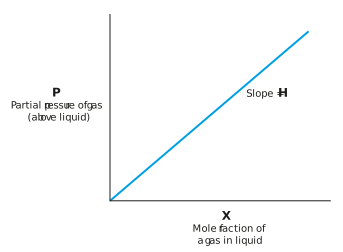
Figure: Henry’s law – partial pressure versus mole fraction
It should be noted that Henry’s law applies to gases of relatively low solubility (e.g. air, oxygen, nitrogen) and also the more soluble gases such as carbon dioxide over a limited range of pressures.
William Henry (1775-1836) was an English chemist and medical physician who due to ill health focused his attentions, not on the medical world, but rather on chemistry. He first developed the view, from experimental observations, that the amount of dissolved gas in a liquid at equilibrium is proportional to its partial pressure above the liquid. Both the (mathematical) law which defines this and the constant of proportionality are named after him.
Partial pressures were covered in a previous lesson in this unit – Dalton’s law of partial pressures - and we also covered how we can practically think of a partial pressure if we are considering a single gas headspace (go back and look at the previous lesson and you’ll see that, for a single gas headspace, the absolute gas pressure can be thought of as the partial pressure). Also covered previously was the concept of molar fractions and something to be wary of is that, in Henry’s law, we are referring to the number of kmoles of the dissolved gas to the total number of kmoles of the liquid (this includes the number of moles of dissolved gas and the liquid itself).
The Henry’s law constant is an experimentally derived constant which was derived at a particular temperature and if you search for values for this constant, you will be amazed (and slightly confused perhaps) at the variety of units that the constant can have. Don’t worry too much about the diversity. Just make sure that the partial pressure and molar fraction units match those of the Henry’s law constant.
Henry’s law constant is in fact a function of temperature as well, and you can seek your own examples of how Henry’s constant varies for a given gas at a given partial pressure.