
Lesson 12 - Control of Fluid Flow 3
This lesson will consider valve technology, which is used to control fluid flow. It will cover the control functions of on-off, and modulating flow control, together with a description of the various valve types which can achieve these functions. The lesson will conclude with thoughts on the issue of managing valve leakage to avoid cross-stream contamination.
Pressure Reducing Valve
Pressure reducing valves are used to control the downstream pressure of a fluid. They are commonly used for utility streams such as steam, water, compressed air, and carbon dioxide.
One of the most common applications you might have seen could be on a bottle of compressed gas in a laboratory or as part of a draught dispense system, which allows the pressure of gas supplied from the bottle to be kept constant. Brewhouse steam systems are often fitted with a pressure reducing valve which would reduce supplied steam from, e.g. 6 bar to a constant supply pressure of 1 bar.
The figure below shows a schematic of a diaphragm pressure reducing valve. In this, a spring exerts a downward force on a flexible diaphragm which is counteracted by the pressure of the downstream fluid. If the upstream pressure increases, the force on the underside of the diaphragm would overcome the spring force. This would cause the valve to move upwards and restrict flow into the valve, thereby reducing the pressure of the downstream fluid. In this way, the spring force value sets and maintains the downstream fluid pressure.
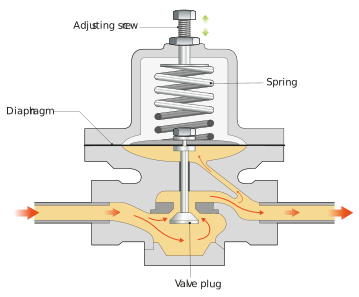
Figure: Diaphragm pressure control valve