
Lesson 12 - Control of Fluid Flow 3
This lesson will consider valve technology, which is used to control fluid flow. It will cover the control functions of on-off, and modulating flow control, together with a description of the various valve types which can achieve these functions. The lesson will conclude with thoughts on the issue of managing valve leakage to avoid cross-stream contamination.
Vacuum Relief Valve
It is not only overpressures which need to be relieved to protect process equipment, but also vacuum pressures. Excessive vacuum pressures can cause vessels, in particular, to implode (commonly termed sucked-in) rather than explode.
There is an old saying that ‘there are two types of brewers: those who have sucked-in a tank, and those who are about to suck-in a tank!’
The best thing to do is install a vacuum relief valve.
Vacuum relief valves (also known as vacuum breakers) open at a specified vacuum pressure, where the vacuum pressure typically overcomes a weight or a spring force. The figure below shows a simple weighted flap which is opened by the vacuum pressure within the vessel. This allows the external atmosphere to enter the vessel and relieve the vacuum. This last point is worth taking note of as typically we relieve a tank vacuum by allowing atmospheric air to enter the vessel, which could negatively affect product quality, e.g. oxygen ingress or microbial contamination.
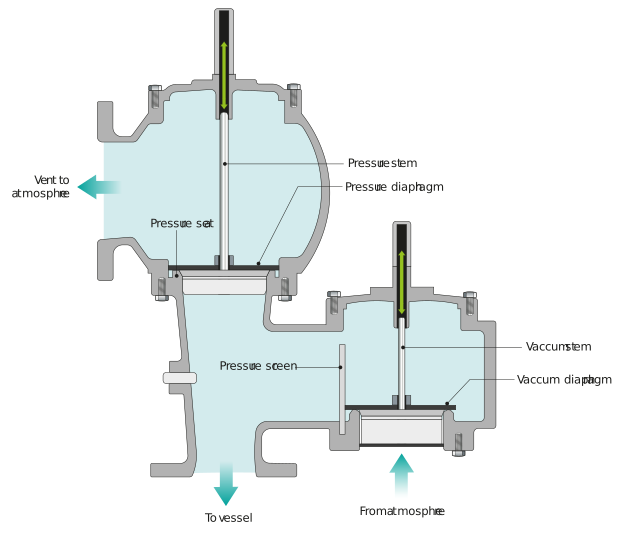
Figure: Combined vacuum and pressure relief valve