
Lesson 12 - Control of Fluid Flow 3
This lesson will consider valve technology, which is used to control fluid flow. It will cover the control functions of on-off, and modulating flow control, together with a description of the various valve types which can achieve these functions. The lesson will conclude with thoughts on the issue of managing valve leakage to avoid cross-stream contamination.
Gate Valve
The gate valve, sometimes known as a sluice valve, is a simple design consisting of a valve element, the gate, which slides at right angles to the flow.
The flow is allowed to pass when the gate is withdrawn from the flow. It is most commonly used as a shut-off valve as small adjustments of the gate give extreme changes in the flow area due to the circular cross-section of pipes. The figure below shows the detail of the valve.
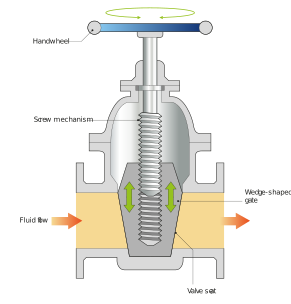
Figure: Gate valve
It is a relatively cheap valve and commonly used to isolate utility streams, but they are not considered hygienic due to the difficulty in cleaning the ‘dead-end’ volume into which the gate is retracted when the valve is opened. Also any solids deposited in the well of the gate can prevent the gate from fully closing which can prohibit it from shutting off. For these reasons, they are not commonly used in product streams.
The gate valve is called so because of the barrier it lifts out of the path of the fluid, to let the flow pass.